

Disclosure: this guide is published by SKUAS Pest Control, one of the companies listed. Ratings and rankings reflect our own assessment.
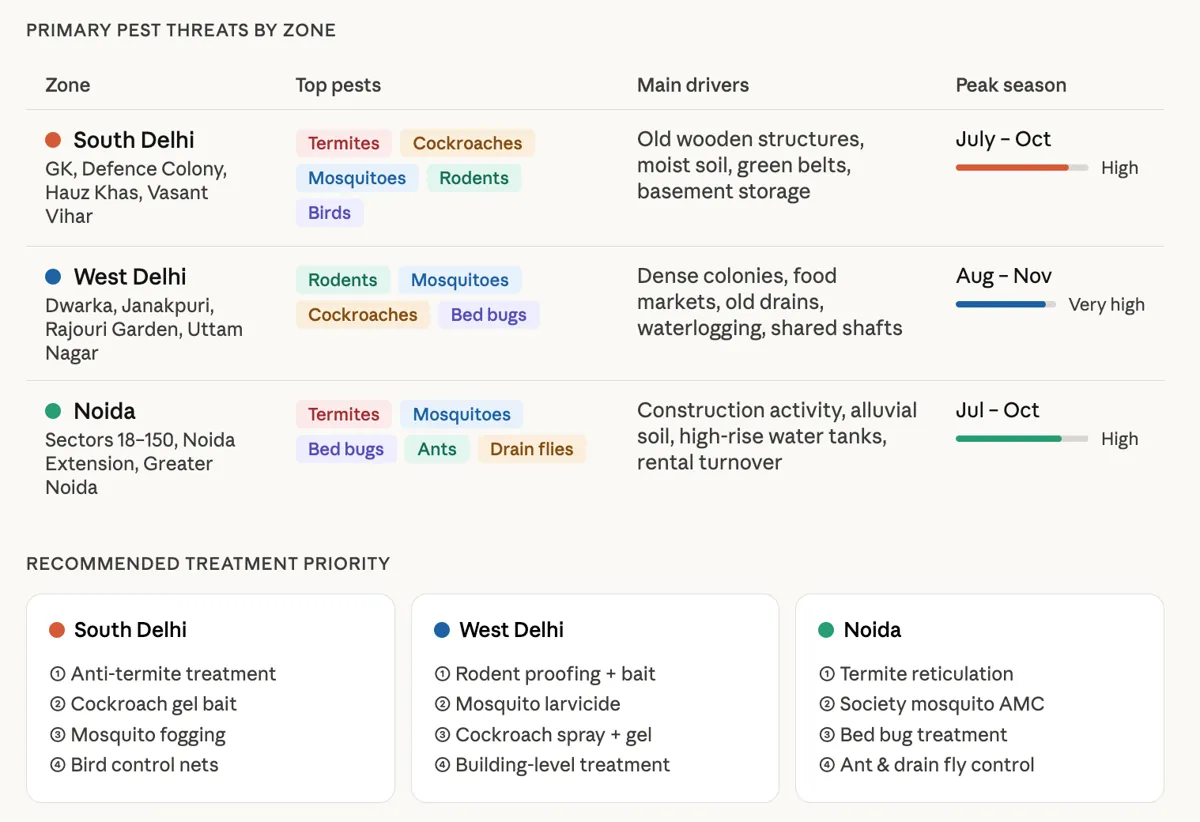
TL;DR: South Delhi faces termites and cockroaches in premium bungalows. West Delhi struggles with rodents and mosquitoes in dense housing colonies. Noida deals with construction-driven termites and mosquitoes in high-rise societies. Each zone needs a different pest control approach, Skuas Pest Control covers all three.
Table of Contents
- Why Pest Problems Differ Across Delhi NCR
- Pest Issues in South Delhi
- Pest Issues in West Delhi
- Pest Issues in Noida
- Zone-by-Zone Comparison at a Glance
- Why One-Size-Fits-All Pest Control Fails
- How Skuas Pest Control Approaches Each Zone
- FAQs
Most pest control blogs treat Delhi NCR as one uniform city. They list cockroaches, termites, and rodents, then offer the same generic advice for every neighbourhood. That is exactly the content gap that leaves residents in Greater Kailash, Janakpuri, or Noida Sector 75 with the wrong treatment for the wrong problem.
The truth is this: pest problems in Delhi NCR are highly location-specific. The type of construction, age of the colony, proximity to drains and green belts, soil moisture levels, and even building materials all determine which pests thrive where. If you are searching for pest control in Delhi that actually works for your specific area, you need locality-level insight, not a generic city-wide guide.
This blog breaks down the top pest issues in South Delhi, West Delhi, and Noida with the precision that residents actually need.
1. Why Pest Problems Differ Across Delhi NCR
Before comparing zones, it helps to understand why the same city produces such different pest profiles across its neighbourhoods.
South Delhi is predominantly older, greener, and home to large bungalows, basement structures, and mature trees, conditions that favour termites, cockroaches, and certain bird species. West Delhi is characterised by dense residential colonies, shared building walls, busy food markets, and older drainage infrastructure that gives rodents and cockroaches ideal conditions to thrive. Noida, on the other hand, is newer but perpetually under construction, with high-rise apartments, soft alluvial soil, and stagnant water near development sites driving mosquito and termite activity in ways that older Delhi colonies rarely experience.
Understanding these structural and environmental differences is the foundation of effective pest control in Delhi NCR.
2. Pest Issues in South Delhi: Termites, Cockroaches & More in Premium Homes
South Delhi covers localities like Greater Kailash (GK 1 & GK 2), Defence Colony, Hauz Khas, Vasant Vihar, Panchsheel Park, CR Park, Saket, and Green Park. These are among Delhi's most established, premium residential zones, and they come with pest challenges that are often more complex than residents expect.
Termites, The Silent Enemy in South Delhi Bungalows
The biggest pest threat in South Delhi is termites, and the reasons are structural. Older bungalows built in the 1960s to 1990s have extensive woodwork, door frames, wooden flooring, roof beams, and built-in furniture, that has never received proper anti-termite treatment. The mature, moist soil beneath these properties supports large subterranean termite colonies year-round. During and after monsoon, termite swarms are a common sight in Green Park, Hauz Khas, and Vasant Vihar gardens.
Cockroaches, A Year-Round Kitchen Menace
South Delhi's premium kitchens, modular cabinets, and under-counter drainage layouts create excellent cockroach harbourage sites. German cockroaches nest deep inside cabinet hinges, under appliances, and inside false ceiling structures, areas that DIY sprays never reach. Even the most expensive, well-maintained South Delhi kitchen is vulnerable if professional gel bait treatment has not been applied.
Mosquitoes from Green Belts and Parks
Lodhi Gardens, Siri Fort Park, and the many private green spaces throughout South Delhi serve as natural mosquito breeding and resting habitats. Aedes aegypti, the dengue mosquito, breeds in the small water collections of flower pots, cooler trays, and garden features commonly found in South Delhi bungalows. Dengue cases from CR Park, Defence Colony, and GK localities are reported every monsoon season without fail.
Rodents and Birds in Basement Structures
South Delhi's older properties frequently have basement storage areas, garden sheds, and servant quarters that are infrequently monitored, creating ideal rodent nesting sites. Pigeon infestations on building parapets and AC ledges are also a persistent complaint in the GK and Hauz Khas belt, with bird droppings causing structural damage and health hazards.
3. Pest Issues in West Delhi: Rodents, Mosquitoes & Dense Colony Challenges
West Delhi includes Janakpuri, Dwarka, Punjabi Bagh, Rajouri Garden, Tilak Nagar, Uttam Nagar, Vikaspuri, and Paschim Vihar. This zone is characterised by densely packed residential colonies, multi-storey builder floors, busy retail markets, and a drainage network under significant pressure.
Rodents, West Delhi's Number One Pest Problem
The rodent problem in West Delhi is driven by a combination of dense housing, active food markets, and older open drainage channels that provide excellent rat highways from sewers directly into residential buildings. Rajouri Garden market, Janakpuri district centre, and the commercial stretches of Tilak Nagar generate significant food waste that sustains large rat populations. These rats then migrate into nearby residential floors through drainage pipes, broken drain covers, and wall gaps.
Norway rats (sewer rats) are the dominant species, burrowing beneath buildings and entering through the ground floor. In multi-floor builder flats, rats travel through shared utility shafts and reach upper floors surprisingly easily. Rodent damage to electrical wiring, a genuine fire hazard, is a particularly common complaint from West Delhi residents.
Mosquitoes, Compounded by Waterlogging
West Delhi's flat topography and ageing drainage infrastructure make it one of the most waterlogging-prone zones in the city during monsoon. Uttam Nagar, Nawada, and parts of Dwarka regularly experience prolonged post-rainfall waterlogging that creates extensive mosquito breeding grounds. Dengue and malaria cases from West Delhi spike sharply from August through October each year.
Dwarka, while newer than older West Delhi colonies, has its own mosquito challenge, the sector-wise layout with parks, lakes, and large open areas means outdoor mosquito pressure is consistently high for residential societies.
Cockroaches in Multi-Floor Properties
In West Delhi's builder floor properties and older DDA flats, shared drainage systems and vertical utility shafts allow cockroaches to migrate between floors freely. A cockroach problem on one floor will reappear on adjacent floors within weeks if the entire building is not treated systematically, something most building residents do not coordinate.
4. Pest Issues in Noida: Construction Termites, High-Rise Mosquitoes & Society Infestations
Noida sectors range from established areas like Sector 18, 22, and 50 to rapidly developing zones like Sector 75, 100, 137, and 150. The city's character as a continuously developing, high-density urban area creates a specific pest profile that differs significantly from both South and West Delhi.
Termites Driven by Construction Activity
Noida's biggest and most underestimated pest issue is termites, specifically driven by continuous construction activity across the city. Construction excavation disturbs and displaces underground termite colonies, which then migrate into finished neighbouring properties seeking new food sources. Noida's alluvial soil, soft, moisture-retaining, and rich, is ideal for subterranean termite colony growth.
New apartment owners in Noida frequently discover termite damage within the first 2-3 years of occupation, particularly in properties where pre-construction anti-termite soil treatment was either skipped or applied inadequately by the builder. This is one of the most common and costly pest control complaints Skuas Pest Control receives from Noida residents.
Mosquitoes in High-Rise Society Environments
High-rise apartment societies in Noida present a unique mosquito challenge. Water tanks, terrace gardens, clogged society drains, and construction site water pooling near residential towers create multiple simultaneous breeding sources. Aedes aegypti breeds in the water stored in overhead tanks and cooler units on individual flat terraces, meaning even residents on the 15th floor are not immune to dengue mosquito exposure.
Society-level mosquito control, coordinated across the entire residential complex, is essential in Noida but rarely executed comprehensively without professional management.
Bed Bugs in Rental Properties
Noida's large working-professional and student population creates high residential turnover in rental accommodations across Sector 62, 63, Noida Extension, and similar IT-belt localities. High turnover combined with second-hand furniture, shared PGs, and inconsistent cleaning standards makes bed bug infestations particularly prevalent in this segment of the Noida rental market.
Ants and Drain Flies in New Constructions
Brand-new flats in Noida frequently experience ant invasions and drain fly infestations in the first year of occupation, a direct consequence of construction debris, residual concrete moisture, and unsealed wall cavities that provide nesting environments in otherwise clean new properties.
5. Zone-by-Zone Pest Comparison at a Glance
6. Why One-Size-Fits-All Pest Control Fails in Delhi NCR
The single biggest mistake Delhi NCR residents make is hiring a pest control provider who applies the same treatment protocol regardless of locality, property type, or pest species. A spray treatment that works for German cockroaches in a South Delhi kitchen will not resolve a rodent infestation in a West Delhi builder floor. A termite treatment designed for an old bungalow is entirely different from what a Noida high-rise apartment requires.
Effective pest control in Delhi demands locality-specific diagnosis. That means understanding which pest species are prevalent in that specific zone, what environmental and structural factors are driving the infestation, and what treatment method will deliver lasting results in that property type. Shortcuts in any of these steps produce temporary results followed by frustrating recurrence, which is exactly why so many Delhi residents find themselves calling a second or third pest control company within months of the first treatment.
7. How Skuas Pest Control Approaches Each Zone
Skuas Pest Control brings locality-specific expertise developed through years of serving homes and businesses across South Delhi, West Delhi, and Noida. Our approach begins with a proper site inspection, not a phone-based quote, that assesses your specific property, pest species, infestation severity, and local environmental factors before any treatment is recommended.
For South Delhi properties, we prioritise comprehensive anti-termite treatments including reticulation systems for older bungalows, precision gel bait application for cockroach elimination in premium kitchens, and targeted mosquito management programs timed to the green belt seasons. For West Delhi clients, we focus on structural rodent proofing combined with bait station programs, building-level cockroach treatment coordination, and pre-monsoon larvicide treatment for waterlogging-prone localities. For Noida societies and apartments, our termite treatment programs account for ongoing construction activity in the surrounding area, while our society-level mosquito AMC programs provide coordinated protection across entire residential complexes.
All treatments use CIB-approved, eco-safe chemicals that are harmless to your family, children, and pets when correctly applied by our licensed technicians. Every service comes with a written warranty and dedicated follow-up support.
FAQs
Q1. Which Delhi zone has the worst termite problem?
South Delhi and Noida are the two most termite-affected zones, but for different reasons. South Delhi's older bungalows with untreated woodwork and mature soil host large established termite colonies. Noida's active construction sites continuously displace and redirect termite colonies into newly built residential properties. Both require professional treatment, but the type of treatment differs significantly between the two.
Q2. Why are rodents so common in West Delhi specifically?
West Delhi's combination of dense residential colonies, active food markets, older drainage infrastructure, and shared utility shafts in multi-floor buildings creates near-ideal conditions for rodent populations. Rats use sewer networks as highways, surfacing through drains and gaps into residential buildings. Without structural proofing, sealing all entry points, rodenticide alone will not provide lasting results.
Q3. Do Noida high-rise residents really need termite treatment?
Yes, and more urgently than most realise. Noida's alluvial soil is highly favourable for subterranean termite colonies. Ongoing construction in Noida displaces existing termite colonies that then migrate into finished residential buildings. Many builders apply minimal or inadequate pre-construction anti-termite treatment, leaving new owners vulnerable. An anti-termite inspection within the first year of occupation is strongly recommended.
Q4. Is society-level pest control better than individual flat treatment in Noida?
For mosquitoes and cockroaches in high-rise societies, yes, significantly so. Individual flat treatment addresses the infestation within one unit but does nothing to stop re-infestation from shared drainage shafts, common areas, or adjacent flats. Society-level coordinated treatment through an AMC with Skuas Pest Control provides comprehensive, sustained protection for all residents.
Q5. How often should South Delhi bungalow owners get professional pest control?
A minimum of twice yearly, pre-monsoon (April-May) and post-monsoon (October-November), with an annual termite inspection. Older bungalows with established termite history benefit from quarterly inspections and an Anti-Termite Reticulation System for permanent, renewable soil barrier protection.
Q6. Are Skuas Pest Control services safe for children and pets?
Yes. Skuas Pest Control uses only CIB-registered, WHO-approved chemicals applied by licensed technicians following established safety protocols. Our odourless gel bait treatments for cockroaches require no property evacuation. All treatments come with clear post-service guidelines to ensure your family's complete safety.
Skuas Pest Control, Certified Pest Management Specialists for South Delhi, West Delhi & Noida. Licensed | Eco-Safe | Locality-Specific Solutions | Call for a Free Inspection Today.
Disclaimer: Results may vary based on infestation severity and property type. All treatments use CIB-approved chemicals. Skuas Pest Control recommends a professional site inspection for accurate treatment recommendations.