
Anti-Termite Reticulation System for Hospitals & Healthcare

Quick answer

For hospitals and clinics, SKUAS installs TermiPore porous pipe under new blocks and in external trenches around running buildings, charged with Envu Premise SC at the IS 6313 dose. Refills every 2 to 3 years are done from outdoor junction boxes, without drilling into wards, OTs or corridors, and each round is logged for the facility file.

TermiPore porous pipesEnvu Premise SC termiticideDosage as per IS 6313Written SKUAS warrantyServing since 2012

A hospital cannot close a ward because termites have reached the records room. Patient files, wooden nurse stations, door frames in OPD blocks and false ceilings in older wings all give termites something to feed on, and the building is occupied every hour of the day. Conventional treatment of an existing hospital means drilling floors in corridors and rooms, with dust and noise in spaces that infection-control teams work hard to keep clean.

Reticulation moves most of that work outside the clinical areas. For new blocks and extensions, pipe goes in before the floor is cast. For running buildings, pipe runs in a trench along the external walls. Either way, later refills happen at junction boxes outside, so the biomedical, housekeeping and infection-control teams plan around a short outdoor job rather than a drilling programme inside the wards.

Termite risks specific to hospitals & healthcare

Drilling dust in clinical spaces

Drill-fill-seal treatment makes holes in the floor at close intervals and generates fine dust. In operating theatres, ICUs, CSSD and dialysis units that dust is not acceptable, and even in general wards it disturbs patients and staff. Some areas would need a shutdown and a cleaning cycle before reuse, which a busy hospital rarely has room for.

Records, stores and wooden fixtures

Medical records rooms, pharmacy stores packed with cartons, linen stores and older wings with wooden partitions all attract termites. Damage often appears first in a store nobody visits daily. By the time a file rack collapses, the colony has travelled through expansion joints and service ducts into the adjoining areas.

Audit trails for facility management

Accreditation assessors and hospital administrators expect pest management to be documented: what was used, where, when and by whom. A pest control visit that leaves no record is hard to defend during an inspection, and a treatment that cannot be repeated on a schedule leaves gaps in the file year after year.

How we handle it

Pre-floor pipe for new blocks

In new wings and extensions, pipe is laid along wall lines and as an under-floor grid before the PCC, so the clinical areas above never need drilling for termite treatment later.

External trench for running buildings

Around occupied blocks, pipe is laid in a trench along the outer walls and charged from new junction boxes. Indoor drill-fill-seal is limited to non-critical areas with active termites, after agreement with infection control.

Outdoor refills on your timetable

Refills take place at junction boxes outside the building, at hours agreed with the facility manager, with no access needed to wards, OTs or ICUs.

Dated service records

Each charge or refill is recorded with date, chemical, dilution, quantity and loops covered, ready to file with your pest management records for internal or external audits.

What the work looks like on site

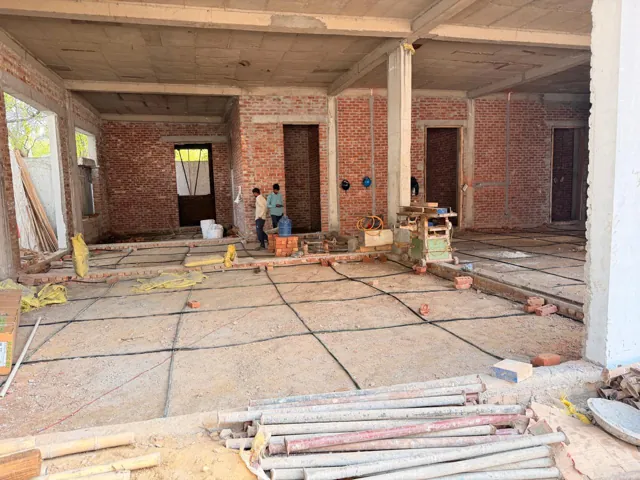
How SKUAS installs an anti-termite reticulation system. Step by step on a SKUAS site: TermiPore porous pipe laid along every wall line, loops joined with connectors, inlet pipe taken out through the plinth to junction boxes, and the full grid ready before the floor PCC.
Black TermiPore porous pipe laid in a grid across a ground floor before the floor PCC is cast
A SKUAS installation in progress: porous pipe laid in a grid across the ground floor and along the wall lines, before the floor PCC is cast.
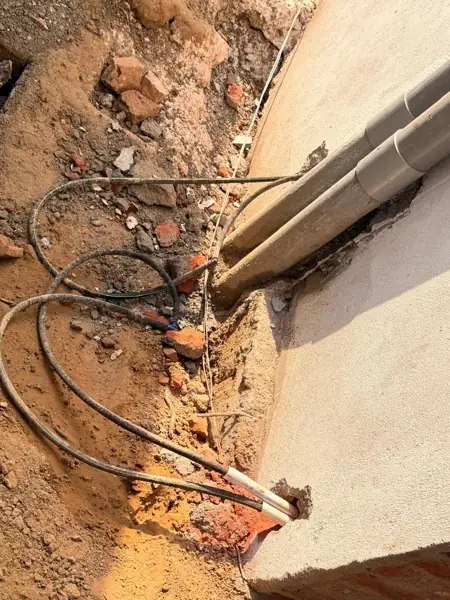
Porous pipe loops joined to plain inlet pipes passing through the plinth wall towards the junction boxes
Pipe loops joined to plain inlet pipes that pass through the plinth wall to the junction boxes used for refilling.

What you get at handover

  • Layout drawing of pipe loops and junction box positions
  • Flow-test record for each loop
  • Dated chemical log for every charge and refill
  • Product label and safety data sheet for Premise SC
  • Refill reminders sent to the facility manager

Pipe and chemical we use

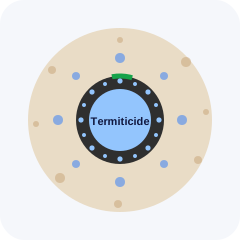
TermiPore porous pipe cross-section showing micro-pores on all sides

The pipe we install

TermiPore porous pipe

Made in Vadodara, Gujarat, India from a thermoplastic elastomeric compound with a honeycomb micro-pore wall. Termiticide seeps out evenly through micro-pores on all sides, unlike hand-drilled PVC that leaks at a few holes. The manufacturer rates pipe life at 30 to 50 years (manufacturer estimate).

Sizes, specs and how to spot genuine pipe
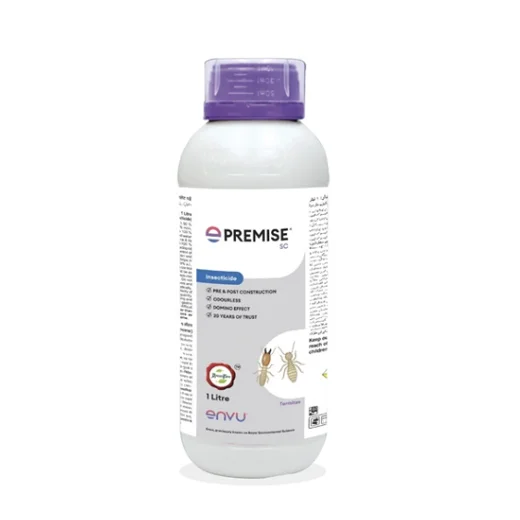
Envu Premise SC termiticide 1 litre bottle

The chemical we charge it with

Envu Premise SC

Imidacloprid 30.5% SC from Envu (formerly Bayer Environmental Science). It is odourless and non-repellent: termites cannot detect it, carry it back to the nest and pass it on to the colony.

Why we use Premise SC

Plans

Hospital blocks usually suit PipeGuard Max, as its annual inspection report and scheduled refills under AMC fit the way facility teams keep records. Small nursing homes and single-building clinics often choose PipeGuard Plus.

PipeGuard Basic

Boundary protection for compact homes

  • Coverage: External boundary (plinth perimeter) only
  • Pipe: TermiPore 17.5 mm (green stripe)
  • Refill points: Junction box every 25 to 30 m
  • Chemical: First charge with Envu Premise SC
  • Warranty: Up to 3 years written SKUAS warranty
  • Refill: Refill recommended every 2 years
  • Flow test before covering
  • Installation photos

Rate: shared after a free site inspection

Get my estimate

PipeGuard Max

Builders, societies and commercial sites

  • Coverage: Boundary, internal walls and under-floor grid
  • Pipe: TermiPore 19.5 mm premium (red stripe)
  • Refill points: Brass-nipple junction boxes every 20 m
  • Chemical: First charge with Envu Premise SC
  • Warranty: Up to 10 years written SKUAS warranty with AMC
  • Refill: Scheduled refills under AMC
  • Pressure and flow test log
  • As-built drawing for handover
  • Annual inspection report

Rate: shared after a free site inspection

Get my estimate

Every site is different. Soil, plinth size, wall layout and access change the final figure, so we confirm the exact rate after a free site inspection. Warranty is SKUAS's own written service warranty; the period depends on the plan and site conditions.

Free estimate in 30 seconds

Reticulation System Estimator

Get the pipe length, number of refill points, chemical quantity and the right plan for your building. Our engineer then shares the exact rate on WhatsApp or call.

Frequently asked questions

Yes. For existing buildings the pipe goes in a trench along external walls, so most of the work happens outside. We plan trench sections to avoid ambulance bays, emergency entrances and oxygen manifold areas, and agree the sequence with your facility and security teams.
Premise SC is odourless, and in a reticulation system it is pumped into pipes in the soil rather than sprayed indoors, so staff and patients should not notice it inside the building. Because the chemical is harmful if swallowed, only our trained applicators handle it, wearing protective equipment.
Critical areas are discussed with the infection-control team first. We usually start by charging the external pipe, since Premise SC is non-repellent and termites carry it back to the colony. Any indoor treatment is scheduled during planned shutdowns, with sealing and cleaning agreed in advance.
We provide dated service records listing the chemical, dilution, quantity and areas covered, along with the layout drawing and flow-test log. These fit into the pest control section of your facility records. We do not issue accreditation certificates; we supply the service evidence your team files.
Yes, and that is the ideal stage. We work with the contractor to lay pipe along every wall line and under the floor before the PCC, then charge it with Premise SC at the IS 6313 dose. The wing then opens with its refill points already in place outside.

Aam sawal (Hinglish)

Haan. Purani building me pipe bahar trench me daala jaata hai, isliye wards ke andar kaam bahut kam hota hai.
Premise SC odourless hai aur mitti ke andar pipe me jaata hai, isliye andar smell mehsoos nahi hoti.
Haan, har refill ki date, chemical, quantity aur area ka record diya jaata hai.

Planning a new building? Book a free site inspection

Our engineer visits, measures the plinth and shares an itemised quote. The best time is before the plinth beam or floor PCC.