
Diwali Offer30% off General Pest Control & Cockroach Control · valid till 15 November 202630% off pest control till 15 NovClaim offer

Termite Control in Jaipur

Quick answer

SKUAS treats termites in existing Jaipur buildings, from walled-city homes to houses in Mansarovar and Jagatpura, by drilling along the floor-wall junction and plinth, injecting Envu Premise SC and sealing the holes, which is the IS 6313 (Part 3) method. Houses still being built should get reticulation. After a free inspection we give you the rate.

IS 6313 (Part 3) methodEnvu Premise SC termiticideWritten SKUAS warrantyServing since 20128,000+ clientsLicensed pest control operator

Jaipur has two very different kinds of housing, and termites attack both. Inside the walled city and in older areas such as C-Scheme, Bani Park and Civil Lines, many homes have heavy timber doors, wooden beams, carved jharokhas and lime-plastered walls that have been in place for generations. Once termites get into that old timber, the damage can stay hidden for a long time behind plaster and paint.

The newer colonies, such as Mansarovar, Malviya Nagar, Vaishali Nagar, Jagatpura and Vidhyadhar Nagar, are mostly independent houses and apartments with modern woodwork: modular kitchens, wardrobes and wooden flooring. Here termites usually appear along the floor edge in ground-floor rooms. In both kinds of building the principle is the same: drill along the floor edges, plinth and frames, put Envu Premise SC into the soil and masonry, and seal, taking extra care around old timber.

Signs of termites to check in Jaipur

Mud tubes

Thin tunnels of soil running up the plinth, walls, pillars or behind skirting. Subterranean termites build them to travel from the soil.

Hollow wood

Door frames, skirting or wardrobe bases that sound hollow when tapped, or crumble at the bottom edge.

Discarded wings

Small wings near windows, lights or door sills after warm days followed by rain. A swarm means an established colony is close by.

Pellets, not mud

Tiny, dry pellets under furniture or frames point to drywood termites, which are found mainly in coastal cities.

Blistered paint or tunnels

Bubbling paint on walls or fine tunnels in wood panelling and wiring battens.

Why termites are a problem in Jaipur

A termite known for damaging woodwork here

A study of termites in the arid north-west of India, which includes parts of Rajasthan, reports that Heterotermes indicola causes extensive damage to woodwork in buildings. It is a subterranean termite, so it reaches doors, frames and beams from the soil through mud tubes and hidden cracks rather than flying straight into the wood. Treating the soil under floors and walls cuts off that route.

Long dry summers and the search for moisture

Jaipur summers are long and very dry. Through the heat, termite colonies stay deep in the ground and come up where they find moisture, which inside a house means bathrooms, kitchens, the area around water tanks and walls with leaking pipes. A damp patch at the base of a wall is often where we find the first mud tubes in a Jaipur home.

Old timber set in thick masonry

Older Jaipur homes often have thick stone or brick walls laid in lime mortar, with wooden lintels, beams and frames set deep inside them. Termites can travel through voids in this masonry without leaving a visible trail. IS 6313 (Part 3) deals with walls by treating the masonry at plinth level, and on old walls we do this with care so the plaster is not disturbed more than needed.

Swarms after the first rains

Jaipur gets most of its rain in the monsoon months, and termite swarms follow the pattern IS 6313 describes: a few warm days followed by rain, in the monsoon or post-monsoon period. Winged termites crowd around lights and leave their wings on floors and sills. Finding those wings indoors means a colony has been living near the house for some time.

Free inspection in Jaipur

Get a call back in working hours

Tell us what you need. Our team calls back with the inspection slot and rate.

How we treat termites in an existing building

For a building that is already finished, the chemical has to reach the soil under the floor and along the foundation. We follow the method set out in IS 6313 (Part 3), the BIS code for treating existing buildings. This is commonly called drill-fill-seal.

  1. Inspection and mapping. We trace how far termites have spread and how they enter, checking floors, skirting, door frames, panelling, wiring battens and switchboards, and remove the mud tubes.
  2. Floor-wall junction. 12 mm holes are drilled at about 300 mm intervals along the junction of floor and walls, and along floor joints, deep enough to reach the soil. Each hole takes termiticide emulsion until it stops absorbing, up to 1 litre, and is then sealed.
  3. Masonry at plinth level. Walls are drilled at a downward angle of about 45 degrees, around 300 mm apart, so the masonry and the soil under it are soaked, then the holes are sealed.
  4. Woodwork in contact with walls and floors. Door and window frames are treated through 6 mm holes drilled at about 45 degrees, with up to half a litre per hole. Badly damaged timber is replaced.
  5. Soil outside the building. Where the soil along the foundation is open, it is treated along the outside walls. Where there is a concrete apron, it is drilled about 300 mm apart and treated through the holes.
  6. Sealing and handover. Holes are sealed and the area cleaned. You get a treatment record and the SKUAS written service warranty for your property.

We use Envu Premise SC (imidacloprid 30.5% SC), one of the termiticides listed by CIB&RC for building termite control, mixed at the dilution on its label. It is odourless and non-repellent, so termites carry it back to the colony.

Which treatment fits your property

The chemical we use

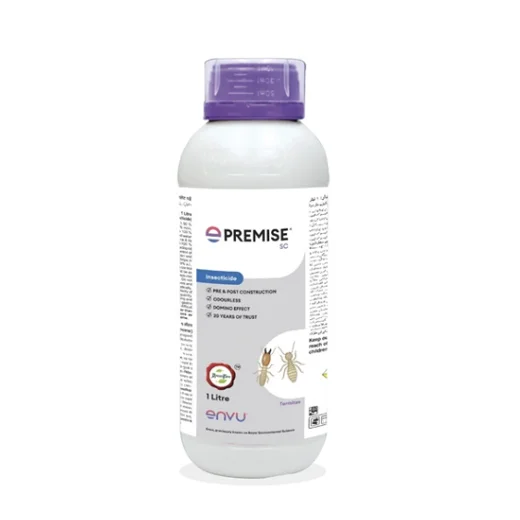
Envu Premise SC termiticide 1 litre bottle

The chemical we charge it with

Envu Premise SC

Imidacloprid 30.5% SC from Envu (formerly Bayer Environmental Science). It is odourless and non-repellent: termites cannot detect it, carry it back to the nest and pass it on to the colony.

Why we use Premise SC

Buildings we treat in Jaipur

Havelis and walled-city homes

Old timber doors, beams, jharokhas and frames set in thick walls, inspected closely before any drilling near fragile plaster.

Independent houses in newer colonies

Ground-floor rooms, kitchens, wardrobes and the plinth line in Mansarovar, Malviya Nagar, Vaishali Nagar and similar areas.

Apartments on Tonk Road and Ajmer Road

Kitchen and wardrobe walls inside the flat, with lower floors and shafts checked when the building has a wider problem.

Hotels, heritage properties and offices

Rooms with wooden furniture and panelling, stores and record rooms, planned so guest areas and offices are worked on in phases.

For Jaipur, our central team travels from New Delhi for scheduled treatments; we plan visits in advance. Send us photos of the damage and your locality when you call, so we can fix an inspection date. Where the inspection and treatment can be done on the same trip, we confirm the equipment and chemical quantity beforehand.

Areas we cover in Jaipur

Walled City, Chandpole, C-Scheme, Bani Park, Civil Lines, Raja Park, Adarsh Nagar, Malviya Nagar, Jawahar Nagar, Mansarovar, Vaishali Nagar, Jagatpura, Vidhyadhar Nagar, Shyam Nagar, Sodala, Nirman Nagar, Jhotwara, Murlipura, Pratap Nagar, Sanganer, Durgapura, Gopalpura, Tonk Road, Ajmer Road, Sikar Road, Sitapura.

Frequently asked questions

We do not publish a fixed rate or a per square foot price list. The cost depends on the plinth or floor area, the number of rooms and walls to be drilled, how far the termites have spread and how much woodwork needs treatment, which can be a lot in older homes. A free inspection gives you a written rate.
After inspecting the house and its woodwork, we drill small holes at the floor-wall junction and along the plinth, inject Envu Premise SC into the soil and masonry, treat frames touching the walls, and seal every hole. Damaged timber is marked for replacement. The full IS 6313 (Part 3) sequence appears in the steps on this page.
The treated soil barrier weakens with time and cannot be expected to last for the life of the building. SKUAS provides a written service warranty, and its period depends on the treatment and the property. We suggest booking an inspection whenever mud tubes, fresh wings or powdery wood appear again.
You can stay at home. The holes are small, and on old lime plaster or stone floors we drill with extra care and seal each hole after injection. Only the room being worked on is kept clear for a short time, and the dust is cleaned up. Premise SC is odourless, so no smell is left behind.
Often, yes, if the timber is still sound inside. Woodwork in contact with walls is treated through drilled holes, and we check beams and lintels for hollow sections. Wood that has been eaten through needs replacing, and the new timber should be treated before it goes in. We mark each piece during the inspection.
Jaipur visits are booked ahead with our team from New Delhi. Call or fill in the form with your locality and a few photos of the damage, and we will give you a visit date. If the house can be treated on the same trip as the inspection, we tell you beforehand.

Aam sawal (Hinglish)

SKUAS ki team New Delhi se aakar treatment karti hai. Visit pehle se plan karte hain.
Agar lakdi andar se khokhli nahi hui to treatment se bach sakti hai. Inspection me bata denge.
Fixed per sq ft rate nahi hai. Ghar dekh kar likhit rate dete hain.

Termites in Jaipur? Book a free inspection

Our engineer visits, measures the plinth and shares an itemised quote. The best time is before the plinth beam or floor PCC.