
Anti-Termite Reticulation System in Ghaziabad

Quick answer

In Ghaziabad, SKUAS installs reticulation for new houses, societies and factories from Indirapuram to Raj Nagar Extension. We lay TermiPore porous pipe under the plinth and wall lines before flooring, fill it with Envu Premise SC at the IS 6313 dose, and recharge it every 2 to 3 years from junction boxes outside, without drilling a single tile.

TermiPore porous pipesEnvu Premise SC termiticideDosage as per IS 6313Written SKUAS warrantyServing since 2012

Ghaziabad builds in two quite different ways. Trans-Hindon areas such as Indirapuram, Vaishali, Vasundhara and Kaushambi were developed as GDA housing and group societies, and some of those buildings are now old enough that ground-floor flats see termites in door frames and kitchen cabinets. Across the river, Raj Nagar Extension and Crossings Republik have filled with newer high-rises, while independent houses in Kavi Nagar, Shastri Nagar and Raj Nagar are being demolished and rebuilt.

Then there is industrial Ghaziabad: Sahibabad Site 4, the Meerut Road and Bulandshahr Road industrial areas, and Loni, where units store packaging, timber and paper at ground level. For every one of these buildings the useful moment is the same. The pipe has to be placed before the ground slab, so that the barrier can be renewed later without breaking the floor.

Termite risk in Ghaziabad: what we plan for

The Hindon river belt

The Hindon runs through Ghaziabad, and Raj Nagar Extension, parts of Indirapuram and the colonies along the embankment sit on its low-lying alluvial land. Soil here stays damp for long stretches after the monsoon, a condition subterranean termites favour. Foundations close to the river belt need a treated zone that can be renewed rather than left to fade.

Ageing Trans-Hindon societies

Many societies in Indirapuram, Vaishali and Vasundhara were built from the 1990s onwards. Their ground-floor flats have wooden frames, modular kitchens and stored goods close to the slab. Where a building was never given a refillable barrier, we combine trench pipe along accessible outer walls with drill-fill-seal inside the flats.

High-rises on former farmland

Raj Nagar Extension and Crossings Republik were agricultural land not long ago, and the towers went up quickly. Colonies from the old fields remain in the soil around podiums, parks and boundary walls. For projects still under construction, pipe along the basement walls and the ground slab is the stage at which to act.

Industrial storage and wooden pallets

Units in Sahibabad, Loni and along Meerut Road often keep pallets, cartons and raw material directly on the ground floor. Termites that get under a warehouse slab can damage stock before anyone notices. Pipe along the boundary, column lines and racking rows lets the plant refill the barrier during a planned shutdown.

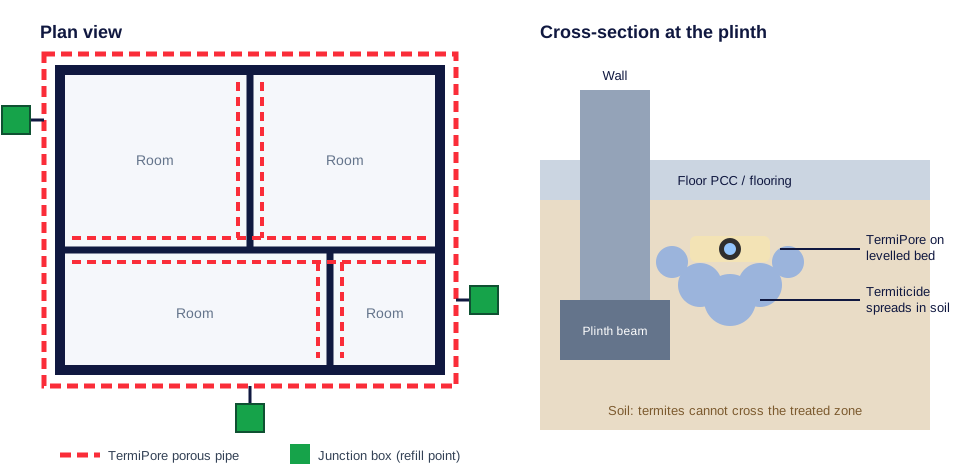
Reticulation pipe layout along boundary and internal walls with junction boxes, and a cross-section at the plinth
Typical layout we install in Ghaziabad: porous pipe along every wall line, refilled through junction boxes outside.

Pipe and chemical we use in Ghaziabad

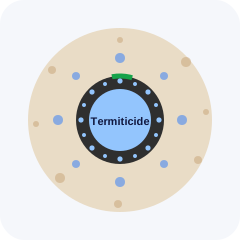
TermiPore porous pipe cross-section showing micro-pores on all sides

The pipe we install

TermiPore porous pipe

Made in Vadodara, Gujarat, India from a thermoplastic elastomeric compound with a honeycomb micro-pore wall. Termiticide seeps out evenly through micro-pores on all sides, unlike hand-drilled PVC that leaks at a few holes. The manufacturer rates pipe life at 30 to 50 years (manufacturer estimate).

Sizes, specs and how to spot genuine pipe
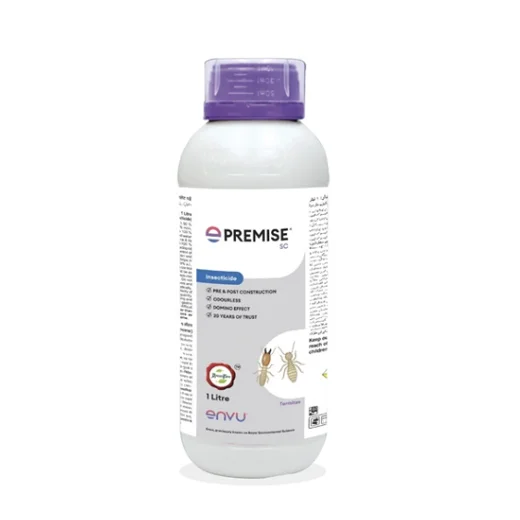
Envu Premise SC termiticide 1 litre bottle

The chemical we charge it with

Envu Premise SC

Imidacloprid 30.5% SC from Envu (formerly Bayer Environmental Science). It is odourless and non-repellent: termites cannot detect it, carry it back to the nest and pass it on to the colony.

Why we use Premise SC

Reticulation plans in Ghaziabad

PipeGuard Basic

Boundary protection for compact homes

  • Coverage: External boundary (plinth perimeter) only
  • Pipe: TermiPore 17.5 mm (green stripe)
  • Refill points: Junction box every 25 to 30 m
  • Chemical: First charge with Envu Premise SC
  • Warranty: Up to 3 years written SKUAS warranty
  • Refill: Refill recommended every 2 years
  • Flow test before covering
  • Installation photos

Rate: shared after a free site inspection

Get my estimate

PipeGuard Max

Builders, societies and commercial sites

  • Coverage: Boundary, internal walls and under-floor grid
  • Pipe: TermiPore 19.5 mm premium (red stripe)
  • Refill points: Brass-nipple junction boxes every 20 m
  • Chemical: First charge with Envu Premise SC
  • Warranty: Up to 10 years written SKUAS warranty with AMC
  • Refill: Scheduled refills under AMC
  • Pressure and flow test log
  • As-built drawing for handover
  • Annual inspection report

Rate: shared after a free site inspection

Get my estimate

Every site is different. Soil, plinth size, wall layout and access change the final figure, so we confirm the exact rate after a free site inspection. Warranty is SKUAS's own written service warranty; the period depends on the plan and site conditions.

Free estimate in 30 seconds

Reticulation System Estimator

Get the pipe length, number of refill points, chemical quantity and the right plan for your building. Our engineer then shares the exact rate on WhatsApp or call.

Buildings we protect in Ghaziabad

Rebuilt houses in Kavi Nagar and Raj Nagar

Plinth-stage loops along every room wall, with ports in the front setback or car porch.

Raj Nagar Extension and Crossings Republik towers

Basement and podium perimeter lines planned with the builder, with refills done from common areas outside the flats.

Ground-floor flats in older societies

External trench pipe where the society permits it, combined with drill-fill-seal inside the flat along every wall joint.

Factories and warehouses

Boundary, column and racking-row pipe for units in Sahibabad, Loni and the Meerut Road industrial area.

How a Ghaziabad installation runs

Our New Delhi head office on Okhla Road covers all of Ghaziabad. For work in an existing society we first meet the RWA or facility manager, because trenching along common walls and fixing junction boxes in shared areas needs their consent. Factory jobs are planned for weekly offs or shutdown days so that production carries on.

  1. Free site visit. We measure the plinth and mark wall lines on your drawing.
  2. Pipe laying. TermiPore pipe on a levelled bed along every planned line, joined to junction boxes.
  3. Flow test. Water is pumped through each loop before the pipe is covered.
  4. First charge. Premise SC at the IS 6313 dose of 5 L per m² of floor area.
  5. Handover. Photos, port layout and your refill reminder schedule.

Chemical quantity per charge

Chemical quantity per charge (IS 6313 dose of 5 L per m² of floor area)
Floor areaDiluted emulsionPremise SC concentrate
500 sq ft≈ 230 litres≈ 490 ml
1,000 sq ft≈ 465 litres≈ 980 ml
1,500 sq ft≈ 695 litres≈ 1.5 litres
2,000 sq ft≈ 930 litres≈ 2.0 litres
3,000 sq ft≈ 1,395 litres≈ 2.9 litres
5,000 sq ft≈ 2,325 litres≈ 4.9 litres
10,000 sq ft≈ 4,645 litres≈ 9.8 litres

Areas we cover in and around Ghaziabad

Indirapuram, Niti Khand, Shakti Khand, Ahinsa Khand, Nyay Khand, Vaishali, Vasundhara, Kaushambi, Raj Nagar, Raj Nagar Extension, Kavi Nagar, Shastri Nagar, Nehru Nagar, Govindpuram, Crossings Republik, Siddharth Vihar, Pratap Vihar, Vijay Nagar, Mohan Nagar, Sahibabad, Sahibabad Site 4, Lal Kuan, Loni, Modinagar, Muradnagar, Meerut Road Industrial Area, Bulandshahr Road Industrial Area.

Frequently asked questions: reticulation in Ghaziabad

Inside the flat, pipe cannot go under a finished floor, so we use drill-fill-seal along the wall joints. Outside, if the RWA allows a narrow trench along the building edge, we lay pipe with junction boxes for future refills. We explain both options and share rates after a free visit.
Low-lying land close to a river tends to stay moist for longer, and moist soil supports subterranean termites. That does not mean every building there has a problem, but it is a sound reason to choose a barrier that can be refilled over a one-time soil treatment.
Ask them to leave a window between the plinth beam and the earth filling for us. On a typical house we need about a day for pipe laying and the flow test. Send the drawing in advance so junction box positions can be agreed before the visit.
For a new shed the pipe goes in before the floor is cast, so production is never affected. In running units we work section by section on weekly offs, combining boundary pipe with drill-fill-seal along columns. Later refills are done from junction boxes outside the production area.
For any work in common areas, yes. Trenching along building edges and fixing junction boxes in shared spaces should be approved by the RWA or the maintenance agency. We can share a short method note for them to review before they decide.

Aam sawal (Hinglish)

Andar drill-fill-seal, aur RWA maan jaaye to bahar ki deewar ke saath pipe.
Nadi ke paas zameen der tak geeli rehti hai, isliye refill hone wala system lagwana samajhdari hai.
Haan, hum weekly off ya shutdown ke din section-wise kaam karte hain.

Building in Ghaziabad? Book a free site inspection

Our engineer visits, measures the plinth and shares an itemised quote. The best time is before the plinth beam or floor PCC.