
Anti-Termite Reticulation System for Factories & Warehouses

Quick answer

SKUAS lays TermiPore porous pipe for factories and warehouses as an under-floor grid before large slabs are cast, and in external trenches around running sheds. The pipe is charged with Envu Premise SC at the IS 6313 dose of 5 L per m² and refilled every 2 to 3 years from perimeter junction boxes, without drilling the floor or moving racks.

TermiPore porous pipesEnvu Premise SC termiticideDosage as per IS 6313Written SKUAS warrantyServing since 2012

In a warehouse, termites do not need to reach the structure to cause a loss. They come up through slab joints, cracks around column bases and gaps at the dock edge, and feed on whatever sits on the floor: corrugated cartons, wooden pallets, paper rolls, packed furniture and dunnage. Stock in the bottom pallet position is often written off before anyone notices mud tubes behind the racking.

Large floors make conventional treatment difficult. Drilling an existing warehouse slab means emptying racks bay by bay, and on a big floor that work drags on while the facility tries to keep running around it. For new sheds and extensions, the floor is the one chance to get a pipe grid under the slab before it is cast. After that, everything has to be done from the perimeter.

Termite risks specific to factories & warehouses

Stock on the floor is the first target

Cartons, pallets and paper-based packaging sit directly on the slab in bulk storage and on bottom rack levels. Termites coming up through joints reach that stock before they reach any wood in the building. Losses show up as damaged goods, rejected shipments and insurance questions rather than as structural damage.

Large slabs with many joints

Industrial floors are cast in panels with saw-cut and construction joints, plus gaps around columns, pits, drains and dock levellers. Each of these is a route up from the soil. Over a large floor the number of entry points is high, so treatment has to cover the soil under the whole slab, not only the boundary.

Racking that cannot be moved easily

Selective racking, mezzanines and bolted machinery make it impractical to clear the floor for drilling. Any treatment that needs floor access across the building means shifting inventory, stopping pick faces and arranging temporary storage, which most operations managers will resist. A method that keeps the floor in use during treatment and refills is far easier to approve.

Sites that keep expanding

Factories and logistics parks add sheds, extensions and new bays in phases. Each new slab is an opportunity to lay pipe before casting, and each missed one becomes a block that can only be protected from its perimeter and by drilling later. Without a site-wide plan, protection ends up uneven from one shed to the next.

How we handle it

Under-slab grid before casting

For new sheds and extensions, we lay a pipe grid under the floor along with the perimeter and internal wall lines, using red-stripe TP125195 under heavy-load zones and keeping it clear of wet concrete.

Junction boxes outside the operating floor

Plain pipe is led out to junction boxes along the external walls or service roads, at runs no longer than 30 m, so refills never need the forklift aisles or the dock area.

Perimeter trench for running facilities

Around existing sheds we lay pipe in a trench along the outer walls and treat inside only where termites are active, bay by bay, in coordination with the warehouse manager.

Phase-wise work around production

Installation follows the slab-casting schedule on new work. On running sites, trenching is fitted around shift timings, truck movements and dispatch peaks agreed with the plant manager.

What the work looks like on site

How SKUAS installs an anti-termite reticulation system. Step by step on a SKUAS site: TermiPore porous pipe laid along every wall line, loops joined with connectors, inlet pipe taken out through the plinth to junction boxes, and the full grid ready before the floor PCC.
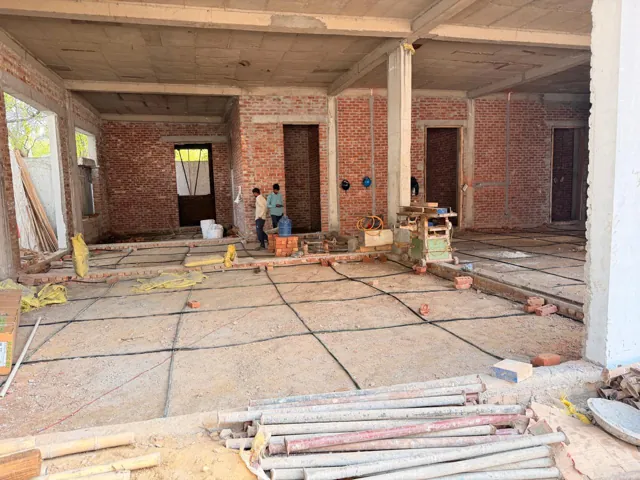
Black TermiPore porous pipe laid in a grid across a ground floor before the floor PCC is cast
A SKUAS installation in progress: porous pipe laid in a grid across the ground floor and along the wall lines, before the floor PCC is cast.
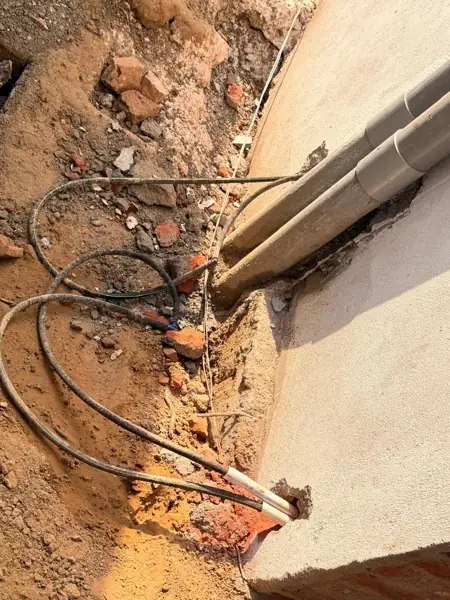
Porous pipe loops joined to plain inlet pipes passing through the plinth wall towards the junction boxes
Pipe loops joined to plain inlet pipes that pass through the plinth wall to the junction boxes used for refilling.

What you get at handover

  • Grid layout drawing with loop lengths and junction box positions
  • Flow-test log completed before the slab is cast
  • Chemical record for first charging and every refill
  • Annual inspection report for the EHS or admin file
  • Refill reminders to the facility or plant manager

Pipe and chemical we use

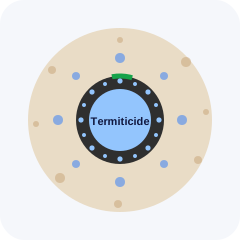
TermiPore porous pipe cross-section showing micro-pores on all sides

The pipe we install

TermiPore porous pipe

Made in Vadodara, Gujarat, India from a thermoplastic elastomeric compound with a honeycomb micro-pore wall. Termiticide seeps out evenly through micro-pores on all sides, unlike hand-drilled PVC that leaks at a few holes. The manufacturer rates pipe life at 30 to 50 years (manufacturer estimate).

Sizes, specs and how to spot genuine pipe
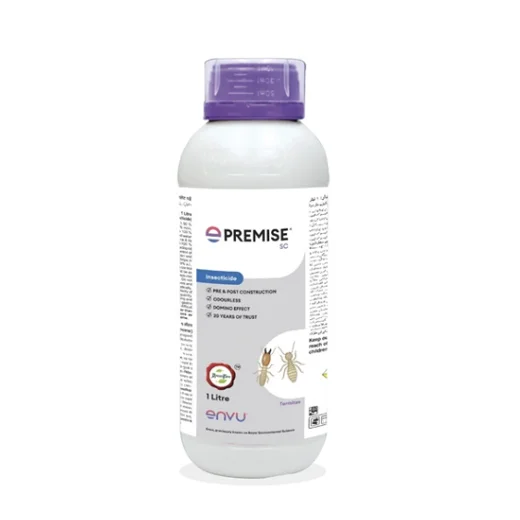
Envu Premise SC termiticide 1 litre bottle

The chemical we charge it with

Envu Premise SC

Imidacloprid 30.5% SC from Envu (formerly Bayer Environmental Science). It is odourless and non-repellent: termites cannot detect it, carry it back to the nest and pass it on to the colony.

Why we use Premise SC

Plans

Factories and warehouses usually need PipeGuard Max, because only the under-floor grid reaches the soil beneath a large slab, and its red-stripe pipe suits heavy-load floors. A small godown in a single shed may manage with PipeGuard Plus.

PipeGuard Basic

Boundary protection for compact homes

  • Coverage: External boundary (plinth perimeter) only
  • Pipe: TermiPore 17.5 mm (green stripe)
  • Refill points: Junction box every 25 to 30 m
  • Chemical: First charge with Envu Premise SC
  • Warranty: Up to 3 years written SKUAS warranty
  • Refill: Refill recommended every 2 years
  • Flow test before covering
  • Installation photos

Rate: shared after a free site inspection

Get my estimate

PipeGuard Max

Builders, societies and commercial sites

  • Coverage: Boundary, internal walls and under-floor grid
  • Pipe: TermiPore 19.5 mm premium (red stripe)
  • Refill points: Brass-nipple junction boxes every 20 m
  • Chemical: First charge with Envu Premise SC
  • Warranty: Up to 10 years written SKUAS warranty with AMC
  • Refill: Scheduled refills under AMC
  • Pressure and flow test log
  • As-built drawing for handover
  • Annual inspection report

Rate: shared after a free site inspection

Get my estimate

Every site is different. Soil, plinth size, wall layout and access change the final figure, so we confirm the exact rate after a free site inspection. Warranty is SKUAS's own written service warranty; the period depends on the plan and site conditions.

Free estimate in 30 seconds

Reticulation System Estimator

Get the pipe length, number of refill points, chemical quantity and the right plan for your building. Our engineer then shares the exact rate on WhatsApp or call.

Frequently asked questions

Yes, if the work is done before the slab is cast. The pipe is laid in a grid on the prepared soil before the PCC or sub-base, kept clear of wet concrete, flow-tested, and then covered. We use the 3.5 mm-wall red-stripe TP125195 where heavy loads are expected.
Not for the pipe system. Pipe goes in a trench along the external walls with junction boxes outside. Inside drilling is needed only in bays where termites are already active, and we treat those bays one at a time, agreed with your warehouse manager, rather than clearing the whole floor.
It depends on the number of loops, but it is an outdoor job at the perimeter junction boxes and does not stop operations. We share the expected duration after the first charge, once we know how each loop takes the emulsion, and plan later refills for the same window.
IS 6313 sets the dose at 5 litres of emulsion per m² of floor area. That works out to roughly 465 litres of emulsion and about 1 litre of Premise SC for every 1,000 sq ft. Large floors need proportionately more, which is why we measure on site before quoting.
We serve Delhi NCR, Jaipur, Mumbai and the Chandigarh tricity, from our head office on Okhla Road in New Delhi and our office in Mohali. Industrial sites in these regions get a free site inspection before we share a rate.

Aam sawal (Hinglish)

Nahi. Pipe shed ki bahari diwar ke saath daalte hain. Andar sirf wahi bay treat hota hai jahan deemak active hai.
Slab cast hone se pehle, poore floor ke neeche grid me.
Nahi. Junction box shed ke bahar hote hain, forklift aur dispatch chalte rehte hain.

Planning a new building? Book a free site inspection

Our engineer visits, measures the plinth and shares an itemised quote. The best time is before the plinth beam or floor PCC.