
TermiPore Porous Pipe

Quick answer

TermiPore is a porous anti-termite reticulation pipe made in Vadodara, Gujarat. Its elastomeric wall has micro-pores on all sides, so termiticide pumped in through a junction box seeps out evenly along the whole run. SKUAS lays it along every wall line during construction and refills it every 2 to 3 years without drilling.
TermiPore porous pipesEnvu Premise SC termiticideDosage as per IS 6313Written SKUAS warrantyServing since 2012
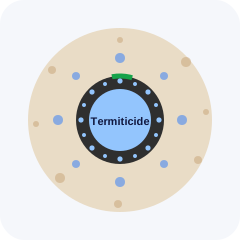
TermiPore porous pipe cross-section with micro-pores releasing termiticide into soil
Cross-section: termiticide leaves the pipe through micro-pores all around the wall and spreads into the soil.

Why a porous pipe works better

The whole point of a reticulation system is an even treated zone along every wall line. If one stretch of soil gets too little chemical, termites find that gap. The pipe decides how evenly the chemical spreads.

TermiPore compared with common alternatives
TermiPore porous pipeHand-drilled PVC pipeDrip irrigation pipe
OutletsMicro-pores all around the wallA few drilled holesFew emitters per metre, one side
Spread along the runEven along the full lengthMost liquid exits at the first holesUneven, one-directional
Blocking by sandPores open under pressure and resist blockingHoles clog easilyEmitters clog
Made for termite workYesNoNo (made for watering plants)

TermiPore sizes and where we use each

TermiPore pipe sizes (manufacturer data)
CodeID × ODWallStripeBest forFlow at 0.25 kg/cm²
TP0951459.5 × 14.5 mm2.5 mmOrangeOn PCC or under tiles6 to 10 L per m per hour
TP12517512.5 × 17.5 mm2.5 mmGreenAll areas (standard choice)8 to 12 L per m per hour
TP12519512.5 × 19.5 mm3.5 mmRedSoil at plinth, heavy load zones8 to 12 L per m per hour

Pipe comes in rolls of 125 m, and the manufacturer states a burst pressure above 30 kg/cm². The green-stripe 17.5 mm pipe is our standard choice. We switch to the red-stripe 19.5 mm premium pipe in plinth soil and heavy-load zones (PipeGuard Max), and use the orange-stripe 14.5 mm pipe where it must sit on PCC under the flooring.
Fittings and junction boxes

  • Plain inlet pipe carries chemical from each junction box to the start of a porous loop.
  • Elbows, tees and end plugs turn corners, split runs and close each loop.
  • Fixing hooks hold the pipe in place on its levelled bed while the trench is backfilled.
  • Junction boxes (about 4 × 4 × 2 inches) sit on the outside wall or in the ground. The rule is one junction box every 20 to 30 m of pipe (30 m maximum); premium boxes use brass nipples.

Installation rules we follow

  1. Levelled bed, never wet cement. Cement slurry can seal the pores, so the pipe always rests on a levelled bed and is covered with soil or sand.
  2. Runs of 20 to 30 m. Each loop is kept short enough for even pressure, with its own junction box.
  3. Flow test before covering. We pump water through every loop and check it seeps along the full length.
  4. Charge at the IS 6313 dose. 5 litres of diluted termiticide per m² of floor area, injected through the boxes.
  5. Record the layout. You get photos and a sketch of where the pipe and every box are.

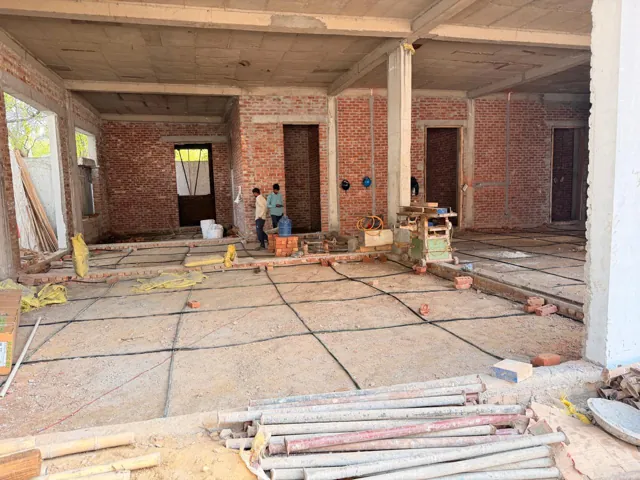
TermiPore installation photos from a SKUAS site

How SKUAS installs an anti-termite reticulation system. Step by step on a SKUAS site: TermiPore porous pipe laid along every wall line, loops joined with connectors, inlet pipe taken out through the plinth to junction boxes, and the full grid ready before the floor PCC.
Black TermiPore porous pipe laid in a grid across a ground floor before the floor PCC is cast
A SKUAS installation in progress: porous pipe laid in a grid across the ground floor and along the wall lines, before the floor PCC is cast.
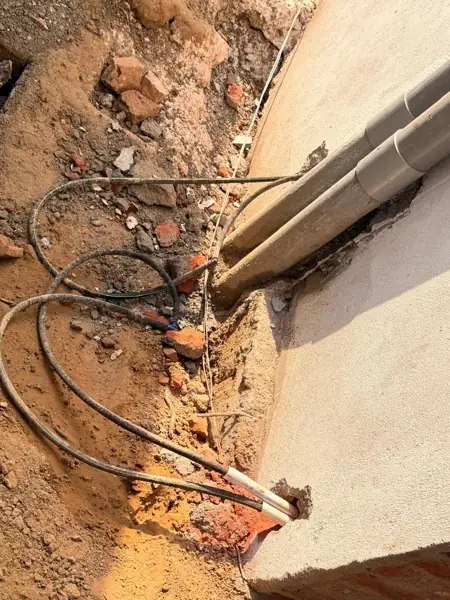
Porous pipe loops joined to plain inlet pipes passing through the plinth wall towards the junction boxes
Pipe loops joined to plain inlet pipes that pass through the plinth wall to the junction boxes used for refilling.

Which chemical goes into TermiPore?

The TermiPore FAQ recommends a reputed-brand termiticide such as imidacloprid or fipronil. We charge every system with Envu Premise SC (imidacloprid 30.5% SC) at the label dilution of 2.1 ml per litre. Read why we chose Premise SC.

How to check you are getting genuine TermiPore

The manufacturer has warned about look-alike pipes sold under its name. Before laying starts, ask your installer to show you the roll, the stripe colour that matches the size code, and the purchase bill. At SKUAS we show the roll on site and include it in your installation photos.

TermiPore at a glance

Made in

Vadodara, Gujarat, India

Pipe life

30 to 50 years (manufacturer estimate)

Refill

Every 2 to 3 years (manufacturer guidance)

Source

termipore.com (manufacturer data)

Free estimate in 30 seconds

Reticulation System Estimator

Get the pipe length, number of refill points, chemical quantity and the right plan for your building. Our engineer then shares the exact rate on WhatsApp or call.

Frequently asked questions

TermiPore is made from a thermoplastic elastomeric compound with a honeycomb wall full of micro-pores. The pores open slightly under pump pressure, so termiticide seeps out evenly on all sides, and they resist blocking by sand.
TermiPore is made in India, in Vadodara, Gujarat. The manufacturer states it is produced by an ISO 9001:2015 certified company.
For most buildings we use the 12.5 × 17.5 mm pipe with a green stripe. Under heavy load or in plinth soil we use the 12.5 × 19.5 mm premium pipe with a red stripe and a 3.5 mm wall. Where pipe must sit on PCC under tiles, the slimmer 9.5 × 14.5 mm orange-stripe pipe is used.
The manufacturer estimates a life of 30 to 50 years. The pipe stays in place; what needs renewing is the termiticide in the soil, which is refilled every 2 to 3 years.
Hand-drilled PVC releases most of the chemical at the first few holes, so the far end of each run gets little. Drip pipe has only a few holes per metre on one side. TermiPore releases liquid through micro-pores along its whole length and all around its wall.
The manufacturer replaces pipe with manufacturing defects, subject to a flow test right after installation. Separately, SKUAS gives its own written service warranty on the installation, depending on the plan.

Aam sawal (Hinglish)

Ye ek porous pipe hai jiski diwar me chhote chhote pores hote hain. Dawai pipe ki poori lambai me charon taraf se barabar nikalti hai.
Har size ki ek colour stripe hoti hai: green (17.5 mm), red (19.5 mm), orange (14.5 mm). Lagane se pehle roll aur bill dekh lijiye.
Company ke hisaab se 30 se 50 saal. Bas har 2 se 3 saal me dawai refill karni hoti hai.

Planning a new building? Book a free site inspection

Our engineer visits, measures the plinth and shares an itemised quote. The best time is before the plinth beam or floor PCC.