
Anti-Termite Reticulation System for Government & PSU Projects

Quick answer

For government and PSU works, SKUAS supplies and lays TermiPore porous pipe along plinth and internal wall lines and charges it with Envu Premise SC at the IS 6313 Part 2 dose of 5 L emulsion per m². Junction boxes allow refills every 2 to 3 years without drilling, and every stage is documented for measurement and audit.

TermiPore porous pipesEnvu Premise SC termiticideDosage as per IS 6313Written SKUAS warrantyServing since 2012

Public works are measured, checked and audited long after the contractor has left. An anti-termite item in a government or PSU building has to match the tender wording, be measurable in the bill, and stand up when the engineer-in-charge or an audit team asks how much chemical went into which block. Reticulation adds one more question: how will the department carry out refills over the life of the building without a fresh tender for drilling work.

We work as the specialist agency, whether the job reaches us through the main contractor or directly from the client department. Our role is to make the item easy to specify, execute and measure: clear specification text, pipe sizes chosen by zone, flow tests witnessed before covering, and a record set that fits a measurement book and a completion file without rework.

Termite risks specific to government & psu projects

Tender wording that cannot be executed

Some tenders ask for a standard mark on reticulation pipe, although no IS standard exists for reticulation pipes. Others specify a pipe without junction box spacing or flow testing, or give a dose without linking it to floor area. Ambiguous wording leads to deviation requests, delays in make approval and disputes at billing.

Measurement and billing disputes

Reticulation can be measured per running metre of pipe, per m² of plinth area or per junction box. If the tender does not say which, the contractor and the department can arrive at very different bills for the same work. The mode of measurement needs to be fixed in the specification, with drawings to support it.

Documentation for audit and handover

Departments expect a paper trail: make approval, delivery challans, test records, chemical issue and consumption, and photographs at each stage. Missing records hold up final bills and make future refill contracts harder to frame, since nobody can say where the loops run or how much emulsion each one took at first charging.

Refills across the life of the building

A pipe system only stays useful if it is recharged every 2 to 3 years. In public buildings, maintenance often passes to a different division after completion. Unless junction box locations and refill quantities are recorded, the next team has no basis to plan, estimate or tender that work, and the system sits unused in the ground.

How we handle it

Specification text before tender

We provide draft specification wording covering make or approved equivalent, sizes by zone, junction box spacing, testing and mode of measurement, so the item can be executed exactly as written.

Inspection-ready execution

Pipe runs are laid as per approved drawings and every loop is flow-tested with water before covering, with the engineer-in-charge or a representative invited to witness and sign.

Chemical accounting

Premise SC containers, dilution at 2.1 ml per litre and emulsion quantity per block are recorded at each charging, so consumption can be checked against the IS 6313 dose for the floor area.

Completion file for the maintenance division

At completion the department receives the as-built drawing, test logs, chemical records and refill quantities per loop, so the maintenance division can plan and estimate future refills.

What the work looks like on site

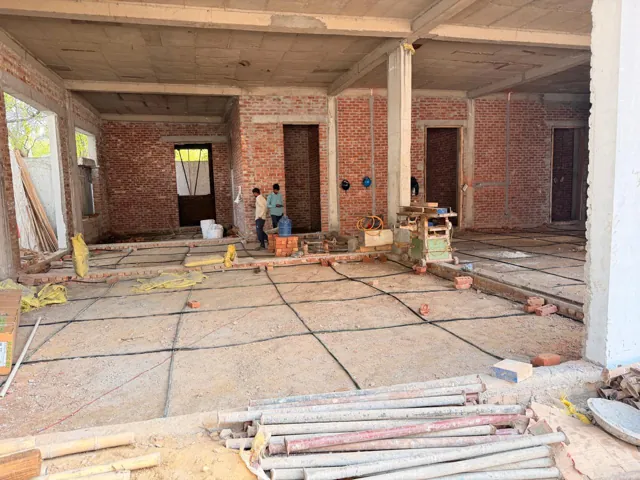
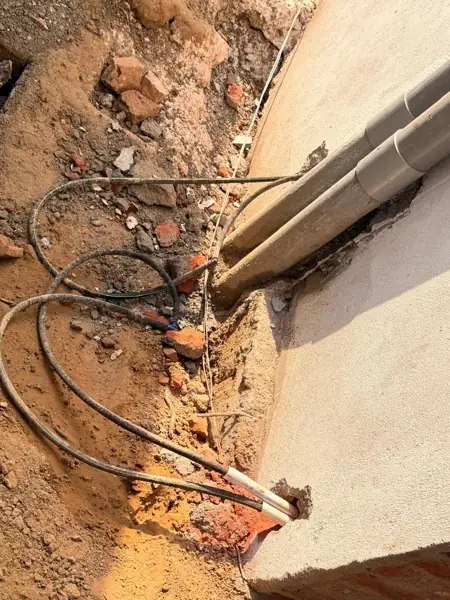
How SKUAS installs an anti-termite reticulation system. Step by step on a SKUAS site: TermiPore porous pipe laid along every wall line, loops joined with connectors, inlet pipe taken out through the plinth to junction boxes, and the full grid ready before the floor PCC.
Black TermiPore porous pipe laid in a grid across a ground floor before the floor PCC is cast
A SKUAS installation in progress: porous pipe laid in a grid across the ground floor and along the wall lines, before the floor PCC is cast.
Porous pipe loops joined to plain inlet pipes passing through the plinth wall towards the junction boxes
Pipe loops joined to plain inlet pipes that pass through the plinth wall to the junction boxes used for refilling.

Specification text you can use

Copy this into your BOQ or tender document and adjust the quantities for your project.

Sample specification

Supply, laying, testing and first charging of anti-termite reticulation system using porous thermoplastic elastomeric pipe (TermiPore TP125175, 12.5 × 17.5 mm, or approved equivalent; TP125195, 12.5 × 19.5 mm, 3.5 mm wall, in plinth soil and heavy-load areas), laid on a levelled bed of soil or sand along the plinth periphery and all internal wall lines before floor PCC, kept clear of wet cement, with junction boxes at intervals not exceeding 30 m. Each loop to be water flow-tested in the presence of the engineer-in-charge before covering. First charging with Imidacloprid 30.5% SC at 2.1 ml/L, 5 L emulsion per m² of floor area as per IS 6313 (Part 2). Pipe measured per running metre; charging per m² of plinth area.

What you get at handover

  • Draft specification and BOQ wording for the item
  • Product literature for pipe and chemical to support make approval
  • Flow-test log signed by the engineer-in-charge
  • Chemical issue and consumption record per block
  • Stage-wise photographs for the measurement book
  • As-built drawing and refill quantities for the maintenance division

Pipe and chemical we use

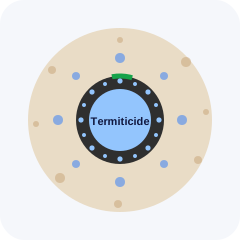
TermiPore porous pipe cross-section showing micro-pores on all sides

The pipe we install

TermiPore porous pipe

Made in Vadodara, Gujarat, India from a thermoplastic elastomeric compound with a honeycomb micro-pore wall. Termiticide seeps out evenly through micro-pores on all sides, unlike hand-drilled PVC that leaks at a few holes. The manufacturer rates pipe life at 30 to 50 years (manufacturer estimate).

Sizes, specs and how to spot genuine pipe
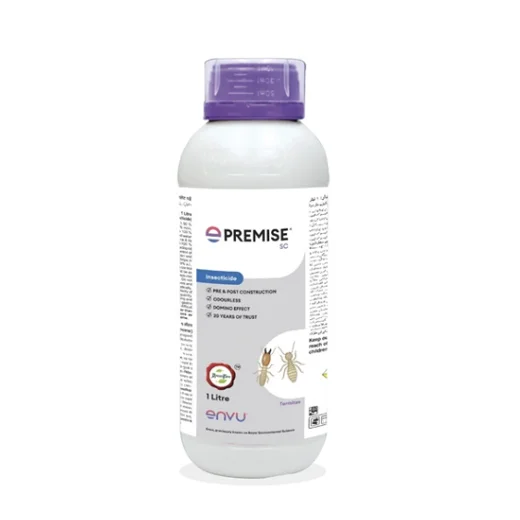
Envu Premise SC termiticide 1 litre bottle

The chemical we charge it with

Envu Premise SC

Imidacloprid 30.5% SC from Envu (formerly Bayer Environmental Science). It is odourless and non-repellent: termites cannot detect it, carry it back to the nest and pass it on to the colony.

Why we use Premise SC

Plans

Government and PSU buildings usually align with PipeGuard Max, since the under-floor grid, pressure and flow test log and as-built drawing match what a completion file needs. The SKUAS written warranty of up to 10 years under Max depends on an AMC for refills, which the department can tender separately.

PipeGuard Basic

Boundary protection for compact homes

  • Coverage: External boundary (plinth perimeter) only
  • Pipe: TermiPore 17.5 mm (green stripe)
  • Refill points: Junction box every 25 to 30 m
  • Chemical: First charge with Envu Premise SC
  • Warranty: Up to 3 years written SKUAS warranty
  • Refill: Refill recommended every 2 years
  • Flow test before covering
  • Installation photos

Rate: shared after a free site inspection

Get my estimate

PipeGuard Max

Builders, societies and commercial sites

  • Coverage: Boundary, internal walls and under-floor grid
  • Pipe: TermiPore 19.5 mm premium (red stripe)
  • Refill points: Brass-nipple junction boxes every 20 m
  • Chemical: First charge with Envu Premise SC
  • Warranty: Up to 10 years written SKUAS warranty with AMC
  • Refill: Scheduled refills under AMC
  • Pressure and flow test log
  • As-built drawing for handover
  • Annual inspection report

Rate: shared after a free site inspection

Get my estimate

Every site is different. Soil, plinth size, wall layout and access change the final figure, so we confirm the exact rate after a free site inspection. Warranty is SKUAS's own written service warranty; the period depends on the plan and site conditions.

Free estimate in 30 seconds

Reticulation System Estimator

Get the pipe length, number of refill points, chemical quantity and the right plan for your building. Our engineer then shares the exact rate on WhatsApp or call.

Frequently asked questions

No. IS 6313 Part 2 covers anti-termite treatment of soil before construction and Part 3 covers existing buildings, but neither is a product standard for the pipe. That is why specifications name a make and size with "or approved equivalent" and link the chemical dose to IS 6313.
Pipe per running metre and chemical charging per m² of plinth area is the clearest split, since both can be checked on drawings and on site. Junction boxes can be included in the pipe rate or measured by number. Whichever is chosen should be stated in the tender.
Yes. Many public works award civil packages to a main contractor, who then engages a specialist for anti-termite work. We coordinate through the contractor's site engineer, follow the approved drawings, and provide records in the format the department's engineers need.
We use Envu Premise SC, which is Imidacloprid 30.5% SC, diluted at 2.1 ml per litre. For make approval we submit the product label, safety data sheet and manufacturer literature. Departments that specify only the active ingredient and dose can assess it on that basis.
IS 6313 Part 3 deals with existing buildings, where the soil along walls and under floors is treated. We lay TermiPore pipe in a trench along the external walls with junction boxes for refills, and treat inside by drill-fill-seal where termites are already active.

Aam sawal (Hinglish)

Make aur size ke saath "or approved equivalent" likhein, aur chemical dose IS 6313 Part 2 ke hisaab se.
Pipe running metre me, aur chemical charging plinth area ke m² ke hisaab se.
Flow-test log, chemical record, photos aur as-built drawing, MB aur completion file ke liye.

Planning a new building? Book a free site inspection

Our engineer visits, measures the plinth and shares an itemised quote. The best time is before the plinth beam or floor PCC.