
Anti-Termite Reticulation System for Hotels & Hospitality

Quick answer

SKUAS protects hotels, resorts and banquet venues with TermiPore porous pipe laid under new buildings or in trenches around operating ones, charged with Envu Premise SC at the IS 6313 dose. Refills every 2 to 3 years happen at outdoor junction boxes during low-occupancy hours, without drilling into guest rooms, restaurants or lobbies.

TermiPore porous pipesEnvu Premise SC termiticideDosage as per IS 6313Written SKUAS warrantyServing since 2012

In a hotel, termite damage is a guest-facing problem. A swollen veneer on a wardrobe, a mud tube behind a headboard or a hollow sound from a wooden floor in the lobby ends up in an online review long before it reaches the engineering department. Hotels invest heavily in timber: panelled corridors, wooden flooring in suites, carved doors, bar counters and back-of-house stores full of linen and cartons.

The building also never really closes. Drilling rooms floor by floor means taking inventory out of sale, and noise in a corridor reaches every guest on that level. Reticulation lets the engineering team protect the soil under and around the property with work that happens mostly outdoors, and later refills become a scheduled outside job that guests do not see.

Termite risks specific to hotels & hospitality

Wooden interiors with high replacement cost

Veneered wardrobes, wall panelling, wooden decks, bar counters and carved doors are expensive to replace and usually custom-made. Termites working inside them leave the surface intact until the damage is well advanced. By the time housekeeping notices, the repair is a carpentry project, often in a room that has to be blocked, rather than a pest control visit.

Banquet lawns and outdoor venues

Banquet lawns, pool decks and garden restaurants keep the soil moist through regular irrigation, which suits subterranean termites. Wooden stages, pergolas, decking and stored furniture next to these lawns are exposed, and the lawn edges often run right up to the banquet hall and kitchen walls. Termites active in the lawn have a short path into the building.

Rooms that cannot go out of inventory

Indoor treatment of an operating hotel means blocking rooms while floors are drilled, filled and sealed, then cleaned. In peak season that is lost revenue; in any season it is noise and dust near occupied rooms. Engineering teams need a method that keeps most of the work outside guest areas.

Back-of-house stores and linen rooms

Linen stores, housekeeping rooms, banquet furniture stores and record rooms usually sit at basement or ground level and hold cotton, cartons and wood. Damage here is noticed late, because the space is busy every day but is rarely inspected for termites. By then, stacked banquet chairs or shelving may already be hollow.

How we handle it

Perimeter pipe around the operating building

For running properties, pipe goes in a trench along the external walls, including the sides facing lawns and pool decks, with junction boxes in service areas rather than guest-facing frontages.

Full grid in new wings and villas

For new towers, cottages or villas, pipe is laid along wall lines and as an under-floor grid before the PCC, in step with your project contractor.

Refills in low-occupancy windows

Refill dates are agreed with the chief engineer to fall on weekdays, early mornings or lean seasons, and the crew works only at outdoor junction boxes, away from guest areas.

Records for the engineering department

You receive a layout of loops and junction boxes, flow-test results and a dated record of every charge, to keep with your preventive maintenance files.

What the work looks like on site

How SKUAS installs an anti-termite reticulation system. Step by step on a SKUAS site: TermiPore porous pipe laid along every wall line, loops joined with connectors, inlet pipe taken out through the plinth to junction boxes, and the full grid ready before the floor PCC.
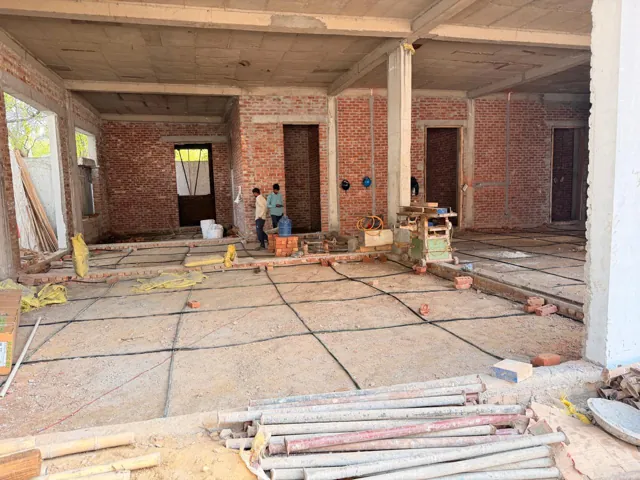
Black TermiPore porous pipe laid in a grid across a ground floor before the floor PCC is cast
A SKUAS installation in progress: porous pipe laid in a grid across the ground floor and along the wall lines, before the floor PCC is cast.
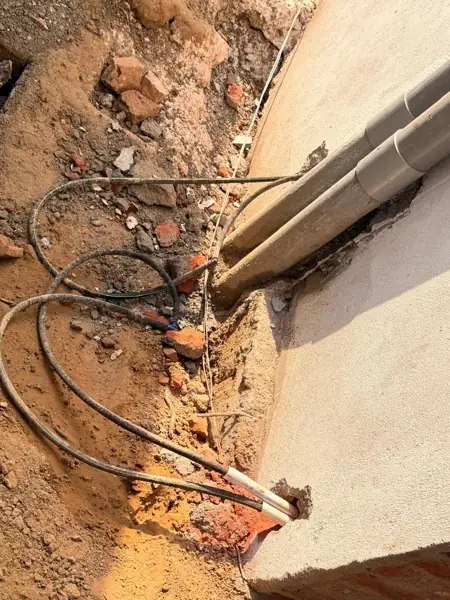
Porous pipe loops joined to plain inlet pipes passing through the plinth wall towards the junction boxes
Pipe loops joined to plain inlet pipes that pass through the plinth wall to the junction boxes used for refilling.

What you get at handover

  • Property layout showing loops and junction boxes
  • Flow-test log for every loop
  • Dated chemical record for each charge and refill
  • Refill reminders to the chief engineer
  • Inspection notes on back-of-house stores and lawn-side areas

Pipe and chemical we use

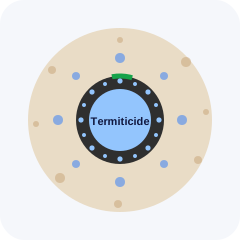
TermiPore porous pipe cross-section showing micro-pores on all sides

The pipe we install

TermiPore porous pipe

Made in Vadodara, Gujarat, India from a thermoplastic elastomeric compound with a honeycomb micro-pore wall. Termiticide seeps out evenly through micro-pores on all sides, unlike hand-drilled PVC that leaks at a few holes. The manufacturer rates pipe life at 30 to 50 years (manufacturer estimate).

Sizes, specs and how to spot genuine pipe
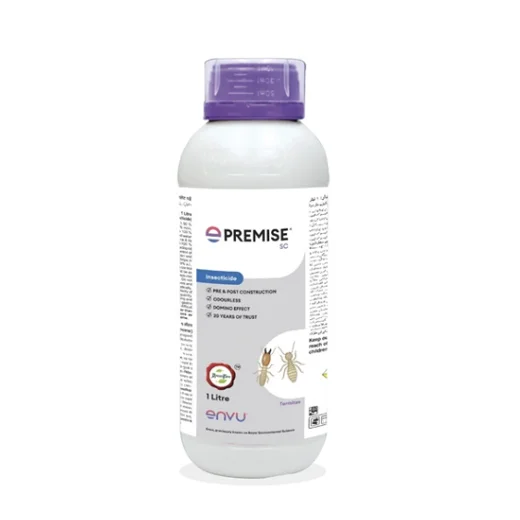
Envu Premise SC termiticide 1 litre bottle

The chemical we charge it with

Envu Premise SC

Imidacloprid 30.5% SC from Envu (formerly Bayer Environmental Science). It is odourless and non-repellent: termites cannot detect it, carry it back to the nest and pass it on to the colony.

Why we use Premise SC

Plans

Hotels and resorts generally go with PipeGuard Max, because refills under AMC and the annual inspection report slot into the engineering department's preventive maintenance calendar. A small boutique property in a single building may choose PipeGuard Plus.

PipeGuard Basic

Boundary protection for compact homes

  • Coverage: External boundary (plinth perimeter) only
  • Pipe: TermiPore 17.5 mm (green stripe)
  • Refill points: Junction box every 25 to 30 m
  • Chemical: First charge with Envu Premise SC
  • Warranty: Up to 3 years written SKUAS warranty
  • Refill: Refill recommended every 2 years
  • Flow test before covering
  • Installation photos

Rate: shared after a free site inspection

Get my estimate

PipeGuard Max

Builders, societies and commercial sites

  • Coverage: Boundary, internal walls and under-floor grid
  • Pipe: TermiPore 19.5 mm premium (red stripe)
  • Refill points: Brass-nipple junction boxes every 20 m
  • Chemical: First charge with Envu Premise SC
  • Warranty: Up to 10 years written SKUAS warranty with AMC
  • Refill: Scheduled refills under AMC
  • Pressure and flow test log
  • As-built drawing for handover
  • Annual inspection report

Rate: shared after a free site inspection

Get my estimate

Every site is different. Soil, plinth size, wall layout and access change the final figure, so we confirm the exact rate after a free site inspection. Warranty is SKUAS's own written service warranty; the period depends on the plan and site conditions.

Free estimate in 30 seconds

Reticulation System Estimator

Get the pipe length, number of refill points, chemical quantity and the right plan for your building. Our engineer then shares the exact rate on WhatsApp or call.

Frequently asked questions

For the pipe system itself, yes, because it is laid in a trench along the external walls. Indoor treatment is needed only where termites are already active inside, and that is planned room by room with the front office so inventory can be managed around it.
We run pipe along the walls of banquet halls, kitchens and other structures that border the lawn, and around fixed wooden features such as stages or decks where the layout allows. The open lawn itself is not piped. We mark irrigation lines before trenching so they are not damaged.
Premise SC is odourless, and the emulsion is pumped into pipes in the soil outside the building, so guests should not notice it. As the product is harmful if swallowed and toxic to aquatic life, we keep it well away from pools and water features, and only trained applicators handle it.
After plinth filling and compaction, before the floor PCC of each villa. We can plan a sequence across several villas so pipe is laid as each one reaches that stage, with junction boxes placed where the landscaping will not cover them.
Once every 2 to 3 years, as TermiPore recommends. Each round is an outdoor job at the junction boxes, planned with the engineering team for a quiet week, and nobody from our crew needs to enter guest rooms or restaurants.

Aam sawal (Hinglish)

Zyada tar haan. Pipe building ke bahar lagta hai, isliye rooms block karne ki zarurat kam padti hai.
Lawn se lagi banquet hall aur kitchen ki diwaron ke saath pipe daala jaata hai.
Har villa ka plinth bharne ke baad aur floor PCC se pehle.

Planning a new building? Book a free site inspection

Our engineer visits, measures the plinth and shares an itemised quote. The best time is before the plinth beam or floor PCC.