
Anti-Termite Reticulation System for Schools & Colleges

Quick answer

SKUAS installs TermiPore porous pipe for schools and colleges in new buildings before the floor is cast and in trenches around existing blocks, charged with Envu Premise SC at the IS 6313 dose. Refills every 2 to 3 years are done from outdoor junction boxes without drilling, and we schedule them in vacations when campuses are empty.

TermiPore porous pipesEnvu Premise SC termiticideDosage as per IS 6313Written SKUAS warrantyServing since 2012

Schools hold more wood than almost any other building type: rows of desks and benches, library shelving, wooden stages in assembly halls, almirahs full of exam records and lab cupboards. Most of it sits on the ground floor, where termites arrive first. A principal usually finds out about the problem when a library shelf gives way or a box of old answer sheets turns to powder in the store room.

The other constraint is time. Treatment work cannot happen during classes, and parents rightly ask what chemical is used anywhere near their children. A reticulation system answers both concerns. The pipe is laid once, and each refill is a short outdoor job at the junction boxes that can be finished during summer, winter or Diwali breaks, with the chemical going into the soil rather than onto any surface students touch.

Termite risks specific to schools & colleges

Libraries and record rooms at ground level

Library stacks, admission files, old registers and exam papers are made of paper and cellulose, which is exactly what termites feed on. These rooms are often on the ground floor for easy access and stay shut for long stretches, so mud tubes along the wall go unnoticed until a full shelf is damaged.

Furniture replaced every few years

Wooden desks, benches and cupboards standing on floors with termite activity get eaten from the legs upwards. Schools then replace furniture in batches, at real cost, without dealing with the soil under the building. Treating the furniture alone does nothing to stop the next batch from being attacked in the same rooms.

Only holidays are available for work

Any drilling, noise or chemical work during term time is disruptive and draws questions from parents. That leaves a few weeks in the summer and winter breaks. A treatment method that needs repeated drilling inside classrooms is hard to fit into those windows across a whole campus, year after year.

Campuses that grow block by block

Many schools and colleges add a new wing, lab or hostel every few years. Each new building is a chance to lay pipe before the floor is cast, but the chance is often missed because nobody briefs the contractor. The older blocks on the same campus then need a different approach.

How we handle it

Work planned around the academic calendar

We plan installation and refills for vacations or weekends, share the schedule with the administrator in advance, and finish the outdoor work before students return.

Pipe in every new block

When a new wing, lab or hostel is being built, we coordinate with the contractor to lay pipe along all wall lines before the floor PCC, so the block starts life with refill points in place.

Trench pipe around older buildings

For existing classroom blocks, we lay pipe in a trench along the external walls and position junction boxes away from play areas, assembly grounds and walkways.

Clear information for parents and staff

We give the school a short note on the product used, how it is applied in the soil and the precautions taken during work, so the administration can answer parent queries.

What the work looks like on site

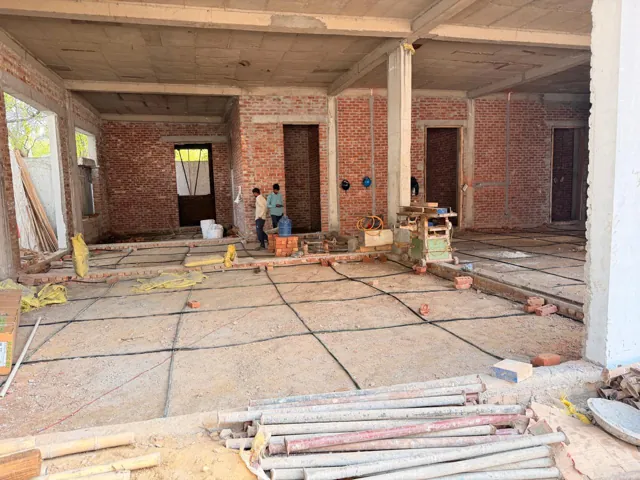
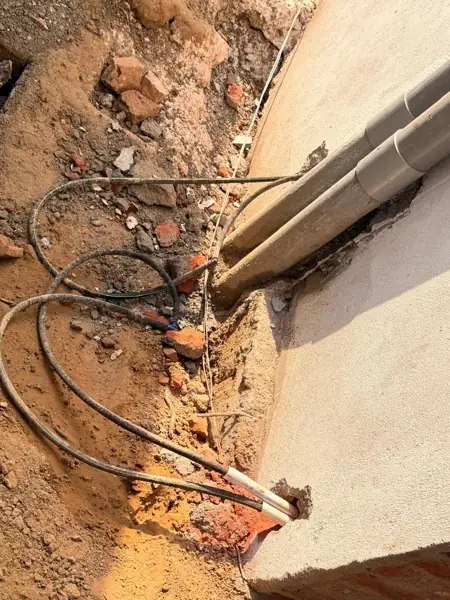
How SKUAS installs an anti-termite reticulation system. Step by step on a SKUAS site: TermiPore porous pipe laid along every wall line, loops joined with connectors, inlet pipe taken out through the plinth to junction boxes, and the full grid ready before the floor PCC.
Black TermiPore porous pipe laid in a grid across a ground floor before the floor PCC is cast
A SKUAS installation in progress: porous pipe laid in a grid across the ground floor and along the wall lines, before the floor PCC is cast.
Porous pipe loops joined to plain inlet pipes passing through the plinth wall towards the junction boxes
Pipe loops joined to plain inlet pipes that pass through the plinth wall to the junction boxes used for refilling.

What you get at handover

  • Campus plan with pipe loops marked block by block
  • Flow-test log for each building
  • Refill record with date, chemical and quantity
  • Product information note for the school office
  • Refill reminders timed to vacations

Pipe and chemical we use

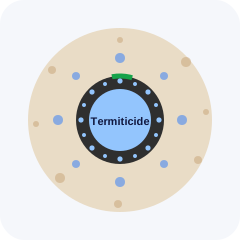
TermiPore porous pipe cross-section showing micro-pores on all sides

The pipe we install

TermiPore porous pipe

Made in Vadodara, Gujarat, India from a thermoplastic elastomeric compound with a honeycomb micro-pore wall. Termiticide seeps out evenly through micro-pores on all sides, unlike hand-drilled PVC that leaks at a few holes. The manufacturer rates pipe life at 30 to 50 years (manufacturer estimate).

Sizes, specs and how to spot genuine pipe
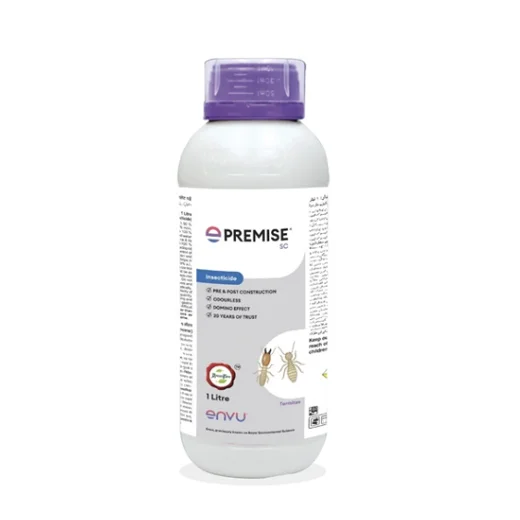
Envu Premise SC termiticide 1 litre bottle

The chemical we charge it with

Envu Premise SC

Imidacloprid 30.5% SC from Envu (formerly Bayer Environmental Science). It is odourless and non-repellent: termites cannot detect it, carry it back to the nest and pass it on to the colony.

Why we use Premise SC

Plans

Schools with several blocks usually choose PipeGuard Max, since scheduled refills under AMC can be lined up with vacations and the annual inspection covers libraries and stores. A single-building school may find PipeGuard Plus enough.

PipeGuard Basic

Boundary protection for compact homes

  • Coverage: External boundary (plinth perimeter) only
  • Pipe: TermiPore 17.5 mm (green stripe)
  • Refill points: Junction box every 25 to 30 m
  • Chemical: First charge with Envu Premise SC
  • Warranty: Up to 3 years written SKUAS warranty
  • Refill: Refill recommended every 2 years
  • Flow test before covering
  • Installation photos

Rate: shared after a free site inspection

Get my estimate

PipeGuard Max

Builders, societies and commercial sites

  • Coverage: Boundary, internal walls and under-floor grid
  • Pipe: TermiPore 19.5 mm premium (red stripe)
  • Refill points: Brass-nipple junction boxes every 20 m
  • Chemical: First charge with Envu Premise SC
  • Warranty: Up to 10 years written SKUAS warranty with AMC
  • Refill: Scheduled refills under AMC
  • Pressure and flow test log
  • As-built drawing for handover
  • Annual inspection report

Rate: shared after a free site inspection

Get my estimate

Every site is different. Soil, plinth size, wall layout and access change the final figure, so we confirm the exact rate after a free site inspection. Warranty is SKUAS's own written service warranty; the period depends on the plan and site conditions.

Free estimate in 30 seconds

Reticulation System Estimator

Get the pipe length, number of refill points, chemical quantity and the right plan for your building. Our engineer then shares the exact rate on WhatsApp or call.

Frequently asked questions

Trench work around existing blocks is usually planned to fit within a vacation. After a free site inspection we give a timeline based on the length of wall to be covered. For a new building, timing depends on when the contractor reaches plinth stage, so we plan around their schedule.
The Premise SC emulsion goes into pipes buried in the soil along walls, not onto desks, floors or playgrounds, and it is odourless. It is harmful if swallowed, so only trained applicators handle it, work is done while students are away, and junction box lids are closed after every refill.
The system treats the soil around and under the building, which is the route subterranean termites take to reach the library. It does not treat books or shelves directly. If termites are already inside the shelving, we advise local treatment of the affected furniture alongside the soil barrier.
Call when the foundation work starts, so we can plan before plinth filling. The pipe has to be laid after the plinth is filled and compacted and before the floor PCC. Missing that window means the hostel will need trench pipe and drilling later instead.
Yes. We map every block, hostel and library on one campus plan and put all of them on a single refill schedule. Buildings constructed in different years can sit under the same AMC, with refill rounds timed for semester breaks.

Aam sawal (Hinglish)

Chhuttiyon me ya weekend par, jab bachche campus me nahi hote.
Pipe us mitti ko treat karta hai jahan se deemak aati hai. Agar shelf me pehle se deemak hai toh uska alag treatment hota hai.
Foundation shuru hote hi. Pipe plinth filling ke baad aur floor PCC se pehle lagta hai.

Planning a new building? Book a free site inspection

Our engineer visits, measures the plinth and shares an itemised quote. The best time is before the plinth beam or floor PCC.