
Anti-Termite Reticulation System for Housing Societies & RWAs

Quick answer

SKUAS works with housing societies and RWAs to refill existing reticulation systems through their junction boxes and to add TermiPore porous pipe in external trenches around older towers. Refills use Envu Premise SC at the IS 6313 dose and are repeated every 2 to 3 years without drilling inside flats, usually under one AMC for all blocks.

TermiPore porous pipesEnvu Premise SC termiticideDosage as per IS 6313Written SKUAS warrantyServing since 2012

Most RWAs inherit their termite problem. The builder may have laid a pipe system, but the drawings never reached the society office, the junction box covers are buried under a garden bed, and nobody remembers when it was last charged. Meanwhile residents report termites in modular kitchens and wardrobes one flat at a time, and each complaint becomes a separate spot treatment paid from the maintenance fund.

A society needs something different from an individual flat owner. It needs one plan for every tower, clubhouse, guard room and basement, a refill calendar the managing committee can track, and work done from common areas so residents are not asked to move furniture. That is how we approach society work, whether the buildings already have pipes in the ground or need a trench system around their outer walls.

Termite risks specific to housing societies & rwas

Pipe systems nobody has charged since handover

Many societies have junction boxes on their outer walls that have not been opened since possession. Without refills, the chemical in the soil runs down and the system becomes a set of empty pipes. Committees often discover this only when termite complaints begin on lower floors, by which time the colony has already found a way in through cracks and service shafts.

Junction boxes lost under landscaping

Over the years boxes get paved over, covered by planters or hidden behind new security cabins and EV charging points. If a refill team cannot find every box, some loops are never charged, and the protection has gaps that nobody notices until wood starts failing in one particular stack of flats.

Complaints handled flat by flat

Treating each affected flat separately drains the maintenance fund and never addresses the soil under the tower. One resident's wardrobe is treated, the termites move to the neighbour's door frame, and the committee pays again. A planned treatment from common areas is easier to budget for and far easier to justify at the AGM.

Common areas that hold the most wood

Clubhouse libraries, gym flooring, wooden decks around pools, temple areas and the society office are often full of timber and paper, and all of them sit at ground level. Because these spaces are shared, nobody owns the problem until the damage is visible. They need to be in the plan alongside the residential towers.

How we handle it

Locate and test the existing system

We trace junction boxes from whatever drawings exist and from checks on site, open each one, and flow-test the loops with water to see which are still usable before any chemical is charged.

Trench pipe for towers without a system

For older blocks, we lay TermiPore pipe in a trench along the external walls and fit new junction boxes, then treat ground-floor areas by drill-fill-seal under IS 6313 Part 3 where needed.

One AMC across all blocks

Every tower, the clubhouse and other common buildings sit on one schedule, with refills every 2 to 3 years and a reminder to the committee before each round falls due.

Work done from common areas

Refills are carried out at outdoor junction boxes, so residents never have to give access to their flats. We share dates with the facility manager so notices can go out in advance.

What the work looks like on site

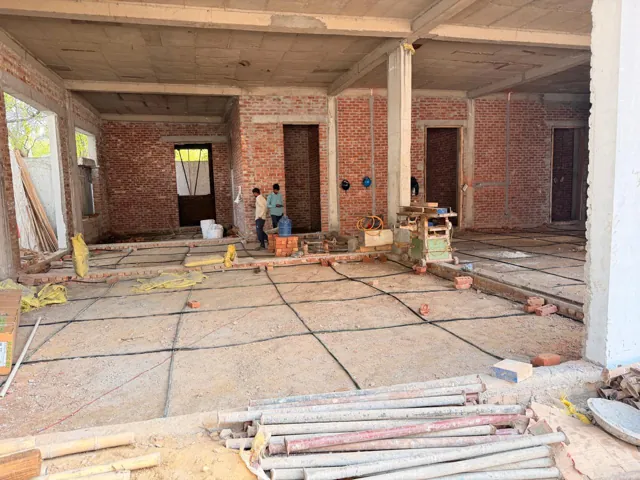
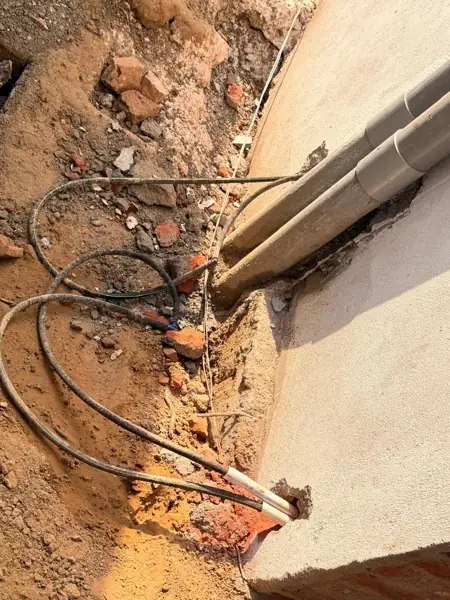
How SKUAS installs an anti-termite reticulation system. Step by step on a SKUAS site: TermiPore porous pipe laid along every wall line, loops joined with connectors, inlet pipe taken out through the plinth to junction boxes, and the full grid ready before the floor PCC.
Black TermiPore porous pipe laid in a grid across a ground floor before the floor PCC is cast
A SKUAS installation in progress: porous pipe laid in a grid across the ground floor and along the wall lines, before the floor PCC is cast.
Porous pipe loops joined to plain inlet pipes passing through the plinth wall towards the junction boxes
Pipe loops joined to plain inlet pipes that pass through the plinth wall to the junction boxes used for refilling.

What you get at handover

  • Tower-wise map of junction boxes and loops
  • Flow-test report on the existing pipe network
  • Refill record with chemical quantity per tower
  • Refill calendar and reminders for the managing committee
  • Inspection notes on clubhouse, library and other timber-heavy common areas

Pipe and chemical we use

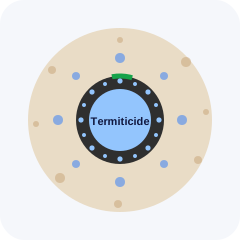
TermiPore porous pipe cross-section showing micro-pores on all sides

The pipe we install

TermiPore porous pipe

Made in Vadodara, Gujarat, India from a thermoplastic elastomeric compound with a honeycomb micro-pore wall. Termiticide seeps out evenly through micro-pores on all sides, unlike hand-drilled PVC that leaks at a few holes. The manufacturer rates pipe life at 30 to 50 years (manufacturer estimate).

Sizes, specs and how to spot genuine pipe
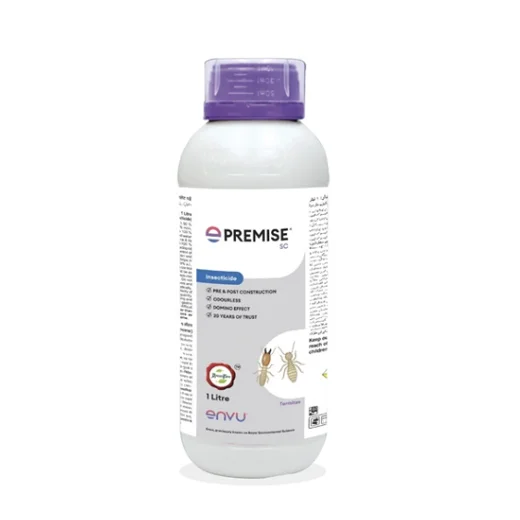
Envu Premise SC termiticide 1 litre bottle

The chemical we charge it with

Envu Premise SC

Imidacloprid 30.5% SC from Envu (formerly Bayer Environmental Science). It is odourless and non-repellent: termites cannot detect it, carry it back to the nest and pass it on to the colony.

Why we use Premise SC

Plans

Societies that already have a pipe network usually move to PipeGuard Max refills, as Max runs on a scheduled AMC and includes an annual inspection report the committee can table at meetings. Older towers that need a new trench system are scoped after a site inspection, since the work depends on how much of each perimeter can be reached.

PipeGuard Basic

Boundary protection for compact homes

  • Coverage: External boundary (plinth perimeter) only
  • Pipe: TermiPore 17.5 mm (green stripe)
  • Refill points: Junction box every 25 to 30 m
  • Chemical: First charge with Envu Premise SC
  • Warranty: Up to 3 years written SKUAS warranty
  • Refill: Refill recommended every 2 years
  • Flow test before covering
  • Installation photos

Rate: shared after a free site inspection

Get my estimate

PipeGuard Max

Builders, societies and commercial sites

  • Coverage: Boundary, internal walls and under-floor grid
  • Pipe: TermiPore 19.5 mm premium (red stripe)
  • Refill points: Brass-nipple junction boxes every 20 m
  • Chemical: First charge with Envu Premise SC
  • Warranty: Up to 10 years written SKUAS warranty with AMC
  • Refill: Scheduled refills under AMC
  • Pressure and flow test log
  • As-built drawing for handover
  • Annual inspection report

Rate: shared after a free site inspection

Get my estimate

Every site is different. Soil, plinth size, wall layout and access change the final figure, so we confirm the exact rate after a free site inspection. Warranty is SKUAS's own written service warranty; the period depends on the plan and site conditions.

Free estimate in 30 seconds

Reticulation System Estimator

Get the pipe length, number of refill points, chemical quantity and the right plan for your building. Our engineer then shares the exact rate on WhatsApp or call.

Frequently asked questions

Usually, yes. If the junction boxes can be found and the loops pass a water flow test, we charge them with Premise SC at the IS 6313 dose. Loops that turn out to be blocked or broken are noted in our report, along with options for a trench pipe along that wall.
No. Refills are done through junction boxes on the outer walls and in common areas, so nobody has to open their flat. We coordinate timing with the facility manager so that gardeners and housekeeping staff keep clear of the work area for that period.
We lay TermiPore pipe in a trench along the external walls of each tower and fit junction boxes for future refills. Pipe cannot be placed under finished floors, so ground-floor flats and common rooms with active termites are treated by drill-fill-seal as per IS 6313 Part 3.
Treat it as a recurring maintenance item, much like water-tank cleaning. The installation or first refill is a one-time cost, and refills follow every 2 to 3 years. We share a rate after a free site inspection, so the committee can put a real figure in front of members.
The emulsion goes into pipes in the soil, not onto surfaces. It is odourless, but it is harmful if swallowed and toxic to aquatic life, so only trained applicators handle it. We cordon off play areas and pond or fountain zones during the work and close the junction box lids afterwards.

Aam sawal (Hinglish)

Haan, agar junction box mil jaayein aur flow test pass ho. Pehle har loop ko paani se check kiya jaata hai.
Nahi. Refill common area ke junction box se hota hai, kisi resident ke ghar me jaane ki zarurat nahi.
Haan, saare towers aur clubhouse ek hi AMC aur refill schedule me aa jaate hain.

Planning a new building? Book a free site inspection

Our engineer visits, measures the plinth and shares an itemised quote. The best time is before the plinth beam or floor PCC.