
Diwali Offer30% off General Pest Control & Cockroach Control · valid till 15 November 202630% off pest control till 15 NovClaim offer

Termite Control in Ghaziabad

Quick answer

SKUAS handles termites in existing Ghaziabad homes, from Indirapuram flats to Raj Nagar houses, by drilling the floor-wall junction and plinth, injecting Envu Premise SC and sealing every hole, following IS 6313 (Part 3). For a building still under construction, we recommend a reticulation system instead. The rate is confirmed in writing after a free inspection.

IS 6313 (Part 3) methodEnvu Premise SC termiticideWritten SKUAS warrantyServing since 20128,000+ clientsLicensed pest control operator

Ghaziabad has a wide mix of housing within a few kilometres. Indirapuram, Vaishali, Vasundhara and Kaushambi have dense blocks of flats and group housing built up over the last few decades, while Raj Nagar, Kavi Nagar and Shastri Nagar have older independent houses with wooden doors, almirahs and staircase railings. Raj Nagar Extension, Crossings Republik and Wave City add newer towers and townships on land that was farmed until recently.

A common complaint in Ghaziabad flats is a wardrobe or kitchen shutter that suddenly crumbles, with lines of mud running behind it. In older independent houses it is usually the bottom of the door frames and the wooden steps of the staircase. Either way, the colony is in the soil, and the fix is to drill along the floor edges, plinth and frames, inject Premise SC and seal, as IS 6313 (Part 3) describes.

Signs of termites to check in Ghaziabad

Mud tubes

Thin tunnels of soil running up the plinth, walls, pillars or behind skirting. Subterranean termites build them to travel from the soil.

Hollow wood

Door frames, skirting or wardrobe bases that sound hollow when tapped, or crumble at the bottom edge.

Discarded wings

Small wings near windows, lights or door sills after warm days followed by rain. A swarm means an established colony is close by.

Pellets, not mud

Tiny, dry pellets under furniture or frames point to drywood termites, which are found mainly in coastal cities.

Blistered paint or tunnels

Bubbling paint on walls or fine tunnels in wood panelling and wiring battens.

Why termites are a problem in Ghaziabad

Older group housing with shared walls

In Indirapuram, Vaishali and Vasundhara, many flats share walls and floor joints with neighbours on more than one side. Termites that settle under one block can travel along these joints and reach several flats. If your neighbour is seeing the same signs, or has had their flat treated recently, it helps to inspect together so the shared walls are covered in one plan.

New townships on former farmland

Raj Nagar Extension, Crossings Republik and Wave City were built on agricultural land, and subterranean termites that lived in those fields remain in the soil around the new towers. Lower-floor flats, clubhouse rooms and shops at ground level are usually the first to show mud tubes. Gardens and planters against the outside walls add moisture and food close to the plinth.

Monsoon swarms near parks and open land

After a few warm days followed by rain in the monsoon or post-monsoon period, winged termites leave mature colonies to swarm. In Ghaziabad localities close to parks, the Hindon and open land, residents often find wings on balconies and window sills the next morning. Wings indoors, near a frame or under a door, are a sign that the colony is close.

Subterranean termites do most of the damage

IS 6313 lists about 220 termite species in India and names subterranean termites as the most destructive to buildings. In neighbouring Delhi, Heterotermes indicola is reported as the most important structural species. These termites keep in contact with the soil, which is why drilling along the floor and plinth matters far more than spraying the surface of furniture.

Free inspection in Ghaziabad

Get a call back in working hours

Tell us what you need. Our team calls back with the inspection slot and rate.

How we treat termites in an existing building

For a building that is already finished, the chemical has to reach the soil under the floor and along the foundation. We follow the method set out in IS 6313 (Part 3), the BIS code for treating existing buildings. This is commonly called drill-fill-seal.

  1. Inspection and mapping. We trace how far termites have spread and how they enter, checking floors, skirting, door frames, panelling, wiring battens and switchboards, and remove the mud tubes.
  2. Floor-wall junction. 12 mm holes are drilled at about 300 mm intervals along the junction of floor and walls, and along floor joints, deep enough to reach the soil. Each hole takes termiticide emulsion until it stops absorbing, up to 1 litre, and is then sealed.
  3. Masonry at plinth level. Walls are drilled at a downward angle of about 45 degrees, around 300 mm apart, so the masonry and the soil under it are soaked, then the holes are sealed.
  4. Woodwork in contact with walls and floors. Door and window frames are treated through 6 mm holes drilled at about 45 degrees, with up to half a litre per hole. Badly damaged timber is replaced.
  5. Soil outside the building. Where the soil along the foundation is open, it is treated along the outside walls. Where there is a concrete apron, it is drilled about 300 mm apart and treated through the holes.
  6. Sealing and handover. Holes are sealed and the area cleaned. You get a treatment record and the SKUAS written service warranty for your property.

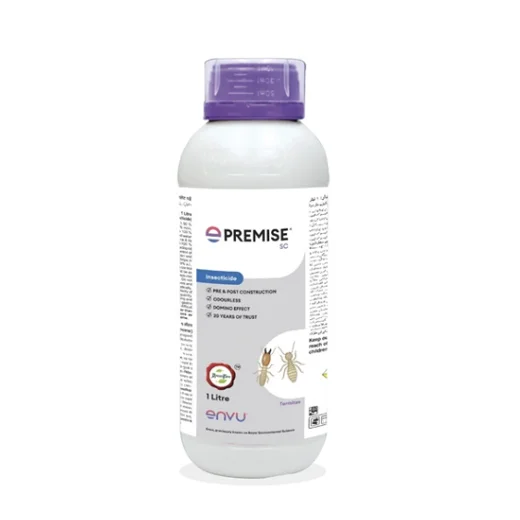
We use Envu Premise SC (imidacloprid 30.5% SC), one of the termiticides listed by CIB&RC for building termite control, mixed at the dilution on its label. It is odourless and non-repellent, so termites carry it back to the colony.

Which treatment fits your property

The chemical we use

Envu Premise SC termiticide 1 litre bottle

The chemical we charge it with

Envu Premise SC

Imidacloprid 30.5% SC from Envu (formerly Bayer Environmental Science). It is odourless and non-repellent: termites cannot detect it, carry it back to the nest and pass it on to the colony.

Why we use Premise SC

Buildings we treat in Ghaziabad

Flats in Indirapuram, Vaishali and Vasundhara

Kitchen, wardrobe and bedroom walls inside the flat, with shared walls checked so the neighbouring flat is not the hidden source.

Independent houses in Raj Nagar and Kavi Nagar

Old door frames, wooden staircases, almirahs and the plinth line, with timber marked for replacement where it cannot be saved.

Towers in Raj Nagar Extension and Crossings Republik

Ground and lower-floor flats, podium shops and clubhouse areas, inspected with the maintenance team when more than one unit is affected.

Shops and units in Sahibabad

Ground-floor showrooms, godowns and factory offices where termites reach stock, cartons, wooden racks and pallets stored against walls.

Ghaziabad is covered from our New Delhi head office on Okhla Road. We often group visits in Indirapuram, Vaishali and Vasundhara on the same day, so share your preferred dates early and we will confirm a time slot. If your society issues gate passes for service staff, please arrange one for our team before the visit.

Areas we cover in Ghaziabad

Indirapuram, Vaishali, Vasundhara, Kaushambi, Raj Nagar, Raj Nagar Extension, Kavi Nagar, Shastri Nagar, Nehru Nagar, Govindpuram, Crossings Republik, Wave City, Shalimar Garden, Sahibabad, Mohan Nagar, Pratap Vihar, Siddharth Vihar, Vijay Nagar, Lal Kuan, Ahinsa Khand, Niti Khand, Shakti Khand, Gyan Khand, Nyay Khand.

Frequently asked questions

Charges depend on your home, not on a fixed list. We look at the plinth or floor area, the number of rooms and walls to drill, how far the termites have spread and what woodwork needs treating, such as frames, wardrobes or a staircase. After a free inspection we give you the rate in writing. We do not publish a fixed price.
The floor cannot be lifted, so we inspect first, then drill small holes along the floor-wall junction and plinth, inject Envu Premise SC down to the soil, treat woodwork that touches the walls and floor, and seal the holes. The full IS 6313 (Part 3) sequence is set out step by step on this page.
The treated soil barrier weakens over time, so termites can return in later years, especially if the soil around the building is dug up or disturbed. SKUAS gives a written service warranty whose period depends on the treatment and the property. If you notice mud tubes, wings or soft wood again, call us for an inspection.
No. Only the room being drilled needs to be cleared of people for a little while, and we cover furniture near the walls. The holes are small, each is sealed once the chemical is in, and the dust is vacuumed. Envu Premise SC has no smell, so you can use the other rooms normally.
It is a good idea. Flats in these blocks share walls and floor joints, so treating one flat while the next stays infested leaves a path open. A joint inspection lets us plan drilling along the common walls once and give each owner a separate written rate for their own flat.

Aam sawal (Hinglish)

Almari hata kar deewar aur farsh ka jod check karna padega. Free inspection book kar lijiye.
Haan, saath me karwana behtar hai. Common deewar ek hi baar me cover ho jaati hai.
Haan, Raj Nagar Extension, Crossings Republik aur Wave City sab cover karte hain.

Termites in Ghaziabad? Book a free inspection

Our engineer visits, measures the plinth and shares an itemised quote. The best time is before the plinth beam or floor PCC.