
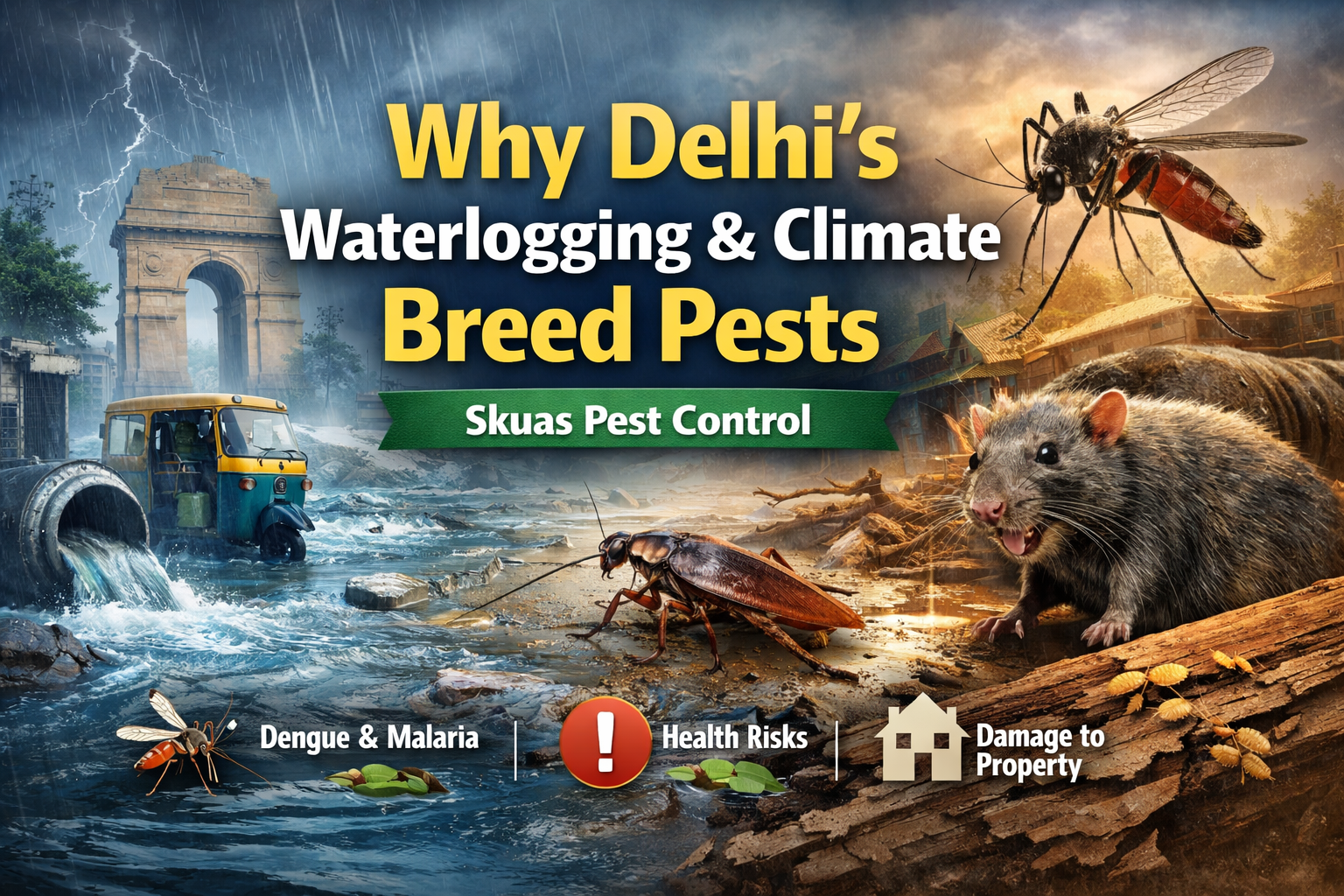
Every year, as the first monsoon clouds gather over Delhi, residents brace for the familiar chaos, flooded underpasses, waterlogged colonies, and traffic grinding to a halt on roads that have turned into rivers. But while the visible disruption of Delhi's monsoon season dominates headlines and dinner table conversations, a far more insidious crisis unfolds quietly in homes, offices, kitchens, and building foundations across the city.
Delhi pest control professionals know this pattern well: within days of the first heavy rainfall, pest infestation calls spike dramatically. Mosquitoes swarm in numbers that make evening time outdoors unbearable. Cockroaches emerge from drains and migrate into kitchens. Termites activate in moisture-laden wooden structures. Rodents, displaced from flooded burrows, find their way into homes and restaurants. The connection between Delhi's waterlogging crisis, its increasingly extreme climate, and the explosion of pest populations is not coincidental, it is scientific, predictable, and urgently important for every Delhi resident to understand.
At Skuas Pest Control, with years of hands-on experience managing pest infestations specifically in Delhi's unique urban and climatic environment, we have seen firsthand how the city's infrastructure challenges and shifting weather patterns have turned pest control from a seasonal concern into a year-round necessity. This guide explains exactly why Delhi breeds pests at the scale it does, and what you can do about it.
2. Understanding Delhi's Waterlogging Problem
2.1 Causes of Waterlogging in Delhi
Delhi's waterlogging problem is not simply a consequence of heavy rainfall, it is the result of decades of urban development outpacing infrastructure capacity. Understanding the root causes helps explain why stagnant water, and the pests it breeds, have become such a persistent feature of Delhi life.
Poor and Overwhelmed Drainage Systems Delhi's storm water drainage network was designed for a city a fraction of its current size and population. The existing drainage infrastructure, much of it decades old, simply cannot handle the volume of water that falls during heavy monsoon downpours. Pipes are undersized, gradients are inadequate, and outfall points into the Yamuna and its tributaries are frequently blocked or insufficient. The result is that water has nowhere to go, it pools on roads, in low-lying areas, in parks, and in the compounds of residential and commercial buildings across the city.
Rapid and Poorly Planned Urbanization Delhi's explosive population growth and rapid construction activity over the past three decades have dramatically reduced the city's natural water absorption capacity. Forests, grasslands, and open soil, which naturally absorb and filter rainwater, have been replaced by concrete roads, paved courtyards, and built-up structures. The natural drainage pathways that once channeled rainwater into the ground or toward water bodies have been severed by construction. Rain that previously soaked into the earth now has no place to go but the surface.
Garbage and Drain Clogging Solid waste management remains one of Delhi's most persistent urban challenges. Garbage accumulates in storm water drains throughout the year, creating blockages that prevent water from flowing freely even when the drainage infrastructure is technically functional. Plastic bags, construction debris, and domestic waste compact inside drain channels, turning them into dams that cause localized flooding with even moderate rainfall.
Construction Sites Delhi's permanent state of construction, infrastructure projects, metro expansion, residential complexes, and commercial developments, creates thousands of sites across the city where earthwork, excavation, and partially completed structures collect and hold rainwater for extended periods. These construction site water pools are among the most productive mosquito breeding environments in the entire city.
2.2 Impact of Stagnant Water
Stagnant water is not merely an inconvenience or an aesthetic problem, it is the foundation upon which Delhi's pest infestation crisis is built. The relationship between standing water and pest proliferation is direct, scientifically well-documented, and operates at a speed that most residents underestimate.
For mosquitoes, stagnant water is not just a habitat, it is an absolute biological requirement. Female mosquitoes must lay their eggs on or near standing water surfaces. Eggs hatch into larvae within 24-48 hours. Larvae develop through four stages into pupae and then into adult mosquitoes within 7-10 days under warm conditions. A single puddle the size of a dinner plate can produce hundreds of adult mosquitoes within a week. Multiply this by the thousands of waterlogged sites across Delhi following heavy rainfall and the scale of mosquito proliferation becomes clear.
Beyond mosquitoes, stagnant water raises the ambient humidity of surrounding environments dramatically. This elevated humidity creates ideal survival and breeding conditions for cockroaches, termites, rodents, and a range of other pest species that struggle to thrive in drier conditions. Damp walls, wet soil beneath foundations, and moisture-saturated wooden structures become pest habitats created directly by waterlogging.
The infection risk compounds this physical pest problem. Standing water in Delhi's urban environment is rarely clean, it mixes with sewage overflow, garbage leachate, and industrial runoff to create contaminated pools that carry their own microbial disease burden independently of the pests they breed.
3. Role of Climate Change in Pest Growth
Delhi's pest problem is not only intensifying because of urban infrastructure failures, it is being dramatically amplified by climate change. The city's climate has shifted measurably over the past two decades in ways that are directly and significantly favorable to pest proliferation.
3.1 Rising Temperatures
Delhi's average temperatures have increased notably over the past 20 years, driven by the urban heat island effect compounded by broader regional climate change. This warming has profound consequences for pest biology. Most pest species are cold-blooded, meaning their metabolic rate, including their reproductive rate, is directly governed by ambient temperature. As temperatures rise, pest reproduction accelerates. Mosquitoes that required 14 days to complete their lifecycle from egg to adult at historical Delhi temperatures now complete the same lifecycle in 7-10 days. Cockroach reproduction cycles similarly accelerate. Termite colony growth rates increase. The practical consequence is that pest populations build to infestation levels faster than they previously did, with less time for residents and pest control services to respond before numbers become overwhelming.
Rising temperatures also extend the active season for many pest species that were previously limited to the warmer months. Mosquitoes that historically became inactive in Delhi's winters are now active for longer periods each year. Termite swarms, which traditionally peaked during early monsoon, are now reported across a broader seasonal window.
3.2 Increased Humidity
Delhi's humidity levels, particularly during and following the monsoon season, have increased in tandem with rising temperatures. High humidity is among the most important environmental factors determining pest survival and proliferation. Many pest species, including cockroaches and termites, desiccate rapidly in dry conditions but thrive when relative humidity exceeds 70%. The increasingly humid conditions across Delhi's monsoon and post-monsoon months have extended the period during which these pest species can survive and reproduce at maximum efficiency.
Humidity also promotes the growth of mold and fungal decay in wooden structures, paper, and organic materials, creating food sources that attract and sustain termite and cockroach populations even in properties that are otherwise well-maintained.
3.3 Irregular Rainfall Patterns
Perhaps the most pest-management-disruptive consequence of climate change in Delhi is the increasing irregularity of rainfall patterns. Historically, Delhi's monsoon followed a relatively predictable pattern that allowed residents and pest control professionals to anticipate and prepare for seasonal infestations. Today, Delhi experiences intense cloudburst events that cause sudden localized flooding, followed by extended dry periods, followed by further heavy rainfall, a pattern that creates repeated cycles of waterlogging, drying, and rewaterlogging.
This unpredictability makes pest infestations harder to anticipate and prevent. Properties that drain well after one rainfall event may be waterlogged for weeks following an unusually intense cloudburst. Construction sites may dry out and refill with water multiple times within a single month. The result is that pest breeding cycles are triggered repeatedly and unpredictably throughout the monsoon season and beyond, leading to infestations at times and in locations that residents and businesses have not prepared for.
4. Common Pests Thriving in Delhi's Waterlogged Climate
This section addresses the specific pest species most directly linked to Delhi's waterlogging and climate conditions, and why each represents a serious concern for the city's residents.
4.1 Mosquitoes: The Most Dangerous Waterlogging Pest
Mosquitoes are the pest most directly and immediately linked to waterlogging pests Delhi residents contend with every monsoon. The connection is biological and absolute: without standing water, mosquitoes cannot reproduce. With the thousands of waterlogging sites created across Delhi by each heavy rainfall, from rooftop water tanks and cooler trays to flooded underpasses and construction excavations, the city becomes an enormously productive mosquito nursery.
The health consequences of Delhi's mosquito explosion are severe and well-documented. Dengue fever, caused by the Aedes aegypti mosquito, has become one of Delhi's most significant annual public health emergencies. Delhi records thousands of confirmed dengue cases every year during peak mosquito season, with hospitals reporting surge demand for beds and platelet transfusions during outbreak peaks. Malaria, transmitted by the Anopheles mosquito, remains endemic across the NCR region. Chikungunya, while less frequently fatal than dengue, causes prolonged and debilitating joint pain that can persist for months after acute infection.
What makes mosquitoes breeding Delhi such an acute problem is the fact that the primary dengue vector, Aedes aegypti, breeds not in polluted outdoor water bodies but in small, clean water collections inside and immediately outside homes. Flower pot saucers, cooler water tanks, clogged gutters, and water collected in discarded containers on balconies are all productive Aedes breeding sites that residents may not recognize as pest hazards.
4.2 Cockroaches: Masters of the Damp Urban Environment
The cockroach problem Delhi experiences peaks dramatically during and immediately after the monsoon season. Cockroaches are moisture-loving insects that thrive in the damp, warm conditions created by monsoon humidity and waterlogging. Their preferred habitats, kitchen drainage pipes, under-sink cabinets, bathroom wall voids, and sewer systems, are all directly affected by monsoon conditions.
Heavy rainfall forces large populations of sewer-dwelling cockroaches, primarily the American cockroach (Periplaneta americana), to move upward through drainage systems and into buildings as their underground habitats flood. These monsoon migrations bring cockroaches into properties in far greater numbers than residents experience during drier months. Simultaneously, the German cockroach (Blattella germanica), already established in kitchens and bathrooms, reproduces more rapidly in the elevated humidity, causing existing indoor populations to grow explosively.
The health implications are serious. Cockroaches contaminate food and food preparation surfaces with Salmonella, E. coli, and a range of other dangerous bacterial pathogens as they forage. Their shed skins and droppings trigger asthma attacks and allergic reactions, particularly in children.
4.3 Termites: The Hidden Structural Crisis Beneath Delhi's Foundations
Termite infestation Delhi reaches its peak activity during and after the monsoon season for reasons rooted in termite biology. Subterranean termites, the dominant species in Delhi NCR, require consistent soil moisture to survive. Dry soil conditions limit their activity by restricting how far workers can travel from the central colony to food sources. When monsoon rains saturate Delhi's soil, termites gain the moisture conditions they require to expand their foraging range dramatically, attacking wooden structures, furniture, and paper materials in buildings they may not have been able to reach during drier months.
The monsoon period is also termite swarming season, the time when reproductive termites with wings (alates) emerge from established colonies in large numbers to mate and establish new colonies. This annual swarming event is one of the clearest visible indicators of termite activity that property owners can observe, and its coincidence with the monsoon reflects the direct link between rainfall, soil moisture, and termite lifecycle events.
Moisture-damaged wood, window frames swollen from humidity, wooden flooring affected by seepage, roof timbers exposed to monsoon leaks, is dramatically more vulnerable to termite attack than sound, dry wood. Termites preferentially target degraded wood, meaning that monsoon-related building moisture problems directly create conditions that accelerate termite infestation.
4.4 Rodents: Displaced, Desperate, and Dangerous
Delhi's monsoon season triggers significant displacement of rodent populations from their typical habitats. Burrows beneath roads, in open plots, and around garbage dumps, the primary habitats of Delhi's urban rat populations, flood during heavy rainfall, forcing rats and mice to seek alternative shelter urgently. Residential buildings, restaurants, offices, and warehouses become targets for these displaced rodents seeking dry harbourage, food, and warmth.
The rodent problem Delhi experiences during monsoon is compounded by the parallel increase in accessible food sources. Flooded garbage disposal systems, overflowing waste bins, and waterlogged organic waste create abundant foraging opportunities for rodents throughout the city. Once rodents establish themselves in buildings, they are extremely difficult to displace without professional intervention, and their capacity for structural damage and disease transmission makes rapid response essential.
5. Why These Pests Are Dangerous
Understanding that Delhi's climate and waterlogging problem breeds pests is important, but fully appreciating the consequences of pest infestations is what motivates the urgent action that effective pest management requires.
Serious Health Risks The diseases transmitted by Delhi's monsoon pest population represent genuine public health threats. Dengue fever can cause fatal hemorrhagic complications. Malaria causes recurring debilitating fever cycles and can become chronic without proper treatment. Leptospirosis, spread through water contaminated by rat urine, causes severe flu-like illness and can lead to kidney and liver failure. Salmonellosis from cockroach-contaminated food causes gastroenteritis that can be severe in children and elderly individuals. The allergens produced by cockroach droppings and shed skin trigger chronic asthma that reduces quality of life year-round.
Severe Property Damage Termite damage is irreversible without structural repair. A colony that has been consuming the wooden elements of a building undetected for a full monsoon season may have caused structural compromise that requires extensive and expensive remediation. Rodents cause damage to electrical wiring, a well-documented fire hazard, water pipes, insulation, and stored goods. The cumulative property damage caused by pest infestations in Delhi runs into crores of rupees annually.
Food Contamination Cockroaches and rodents contaminate food supplies at a scale that far exceeds what most residents recognize. A single rat contaminates approximately ten times more food than it consumes. For restaurants and food businesses, pest-related food contamination creates regulatory compliance failures with serious financial and reputational consequences.
Rapid Multiplication Under Delhi's monsoon conditions, pest populations do not grow linearly, they grow exponentially. A cockroach population doubles every few weeks. A mosquito population can expand from dozens to thousands within a single month of favorable conditions. Rodent populations similarly explode given adequate food and shelter. Every week of delayed action against a developing pest infestation corresponds to a significantly larger problem, and a more complex, expensive treatment requirement.
6. Signs of Pest Infestation to Watch For
Early detection is the single most important factor in minimizing the impact of a pest infestation. Delhi residents should conduct regular inspections of their properties, particularly during and after the monsoon season, watching for these key warning signs:
A persistent musty or ammonia-like odor in rooms, cabinets, or storage areas is frequently an early indicator of cockroach or rodent activity. Pest droppings, small dark pellets from cockroaches or rodents, or fine powder-like frass from termites, found in kitchen cabinets, along skirting boards, or near wooden fixtures indicate active infestation. Unexplained bite marks on skin, particularly marks appearing in lines or clusters during sleep, suggest bed bug activity. Damaged or hollow-sounding wooden furniture, door frames, and flooring are classic termite warning signs. Mud tubes on walls, floor-wall junctions, or foundation edges are definitive evidence of subterranean termite activity. A sudden dramatic increase in mosquitoes inside the property, beyond what is expected for the season, indicates a breeding source nearby. Scratching or scurrying sounds within walls, ceilings, or under floors during night hours strongly indicate rodent activity. Smear marks, greasy streaks left along rodent travel routes on walls and floor junctions, are a reliable indicator of established rat populations.
7. Prevention Tips: What You Can Do Right Now
While professional pest control is essential for established infestations, proactive prevention significantly reduces your vulnerability to pest problems during Delhi's high-risk monsoon season.
7.1 Control Waterlogging Around Your Home
Inspect and clear all drainage points around your property, including roof gutters, balcony drains, and courtyard drain covers, before the monsoon season begins. Ensure that no containers, plant pots, cooler trays, or low-lying areas around your property accumulate stagnant water. Check overhead water tanks for cracks and cover them securely. Fill any low-lying areas in your garden or compound where water pools after rainfall. Report blocked municipal drains in your colony to local authorities, community-level waterlogging prevention directly reduces mosquito breeding in your vicinity.
7.2 Maintain Cleanliness and Waste Disposal
Store all food, including pet food, in sealed, airtight containers. Empty kitchen waste bins daily and ensure they have tightly fitting lids. Clean under kitchen appliances, inside cabinet hinges, and around drainage pipes regularly, these are primary cockroach harbourage sites. Dispose of accumulated paper, cardboard boxes, and organic waste promptly, these materials attract both termites and rodents. Maintain dry, well-ventilated storage areas for wooden furniture and materials.
7.3 Seal Entry Points
Conduct a systematic inspection of your property for gaps, cracks, and openings that could allow pest entry. Seal gaps around pipe penetrations through walls and floors using cement or expanding foam. Install door sweeps on exterior doors. Repair damaged window screens. Cover ventilation openings with fine mesh. Check and repair any damaged drain covers. Particular attention should be paid to the floor-wall junction throughout the property, a primary entry point for both cockroaches and rodents.
7.4 Use Natural and DIY Solutions
While not a substitute for professional treatment, certain natural and DIY measures can supplement your pest prevention efforts. Neem oil and clove oil applied to kitchen surfaces and cabinet interiors can deter cockroaches. Bay leaves placed inside dry food storage containers discourage insect infestations. Copper mesh stuffed into small rodent entry points provides a temporary barrier. Boric acid powder applied carefully along skirting boards and in cabinet corners creates an inhospitable environment for cockroaches. Citronella plants on balconies and terraces provide modest mosquito deterrence in outdoor sitting areas.
7.5 Regular Inspection
Schedule a professional pest inspection at least once before the monsoon season begins, ideally in April or May. This pre-monsoon inspection allows professionals to identify and address conducive conditions, seal entry points, and apply preventive treatments before pest populations begin their seasonal surge. Property owners with a history of termite or rodent problems should consider quarterly professional inspections throughout the year.
8. Why Professional Pest Control Is Essential for Delhi Homes & Businesses
Prevention tips are valuable, but they have limits. When an infestation has already established, and in Delhi's monsoon season, infestations can establish rapidly, DIY methods are fundamentally inadequate for complete elimination.
Over-the-counter mosquito coils, cockroach sprays, rat poison sachets, and household insecticides provide temporary, localized relief at best. They kill exposed individuals without penetrating nesting sites, breeding grounds, or hidden colonies. Surviving populations recover within days to weeks. Repeated exposure to amateur pesticide applications also drives resistance development in common pest species, making subsequent professional treatment more challenging.
Professional pest control delivers what amateur approaches cannot: expert identification of pest species and infestation severity; targeted treatment methods designed specifically for the pest and environment; access to professional-grade products and equipment unavailable to consumers; treatment of nesting sites, breeding grounds, and hidden colonies, not just visible individuals; and documented follow-up to verify treatment effectiveness and catch early signs of re-infestation.
Skuas Pest Control, Delhi's Specialist in Climate-Responsive Pest Management
At Skuas Pest Control, we bring deep local expertise in the specific pest challenges created by Delhi's climate and waterlogging conditions. Our licensed technicians understand not just pest biology but the ways in which Delhi's unique urban environment, its drainage failures, construction patterns, and increasingly extreme monsoon seasons, interacts with pest behavior to create the infestations our clients face.
We offer safe, eco-friendly treatment solutions using CIB-approved chemicals that are effective against pests while maintaining the safety of your family, children, and pets. Every treatment plan we design is customized to your specific property, pest challenge, and seasonal risk profile, not a generic off-the-shelf package applied without assessment. Our Annual Maintenance Contracts provide continuous, year-round protection with scheduled treatments timed to Delhi's seasonal pest activity patterns, ensuring you are never caught unprepared when the monsoon brings its annual pest surge.
From mosquito control and cockroach treatment to termite management and rodent elimination, Skuas Pest Control provides comprehensive, certified pest management backed by genuine local expertise.
9. Conclusion
The relationship between Delhi's waterlogging crisis, its increasingly extreme climate, and the explosive growth of pest populations is not a coincidence, it is a predictable, scientifically understood consequence of urban infrastructure failures meeting accelerating climate change. Every flooded underpass, every waterlogged colony, every moisture-saturated building creates conditions that mosquitoes, cockroaches, termites, and rodents have evolved over millions of years to exploit.
Understanding this connection is the first step toward breaking it. Proactive prevention, controlling waterlogging around your property, maintaining cleanliness, sealing entry points, and scheduling regular professional inspections, can dramatically reduce your exposure to Delhi's monsoon pest surge. But when prevention is insufficient and infestations take hold, professional pest control services Delhi residents can trust become not just helpful but essential.
Do not wait for an infestation to become a crisis. Contact Skuas Pest Control today for a free property inspection and customized pest management plan designed specifically for Delhi's unique climate and waterlogging challenges. Protect your family's health, preserve your property, and face Delhi's monsoon season with genuine confidence.
Call Skuas Pest Control today, because Delhi's pests do not take a season off, and neither do we.
10. Frequently Asked Questions
Q1. Why do pests increase so dramatically during Delhi's monsoon season?
Delhi's monsoon season creates a perfect combination of conditions that directly fuel pest population growth. Heavy rainfall creates thousands of stagnant water pools across the city, the essential breeding medium for mosquitoes. Simultaneously, rising humidity dramatically improves survival and reproduction rates for cockroaches and termites. Flooding displaces rodent populations from their underground burrows into residential and commercial buildings. The combination of warmth, moisture, and displaced pest populations creates the dramatic seasonal infestation surge that Delhi residents experience every year between July and October.
Q2. How exactly does waterlogging cause mosquito infestations in Delhi?
Mosquitoes require standing water to reproduce, female mosquitoes lay their eggs on water surfaces, and larvae develop entirely in aquatic environments before emerging as adults. Delhi's waterlogging creates thousands of breeding sites simultaneously, from large flooded open areas to small water collections in flower pots and cooler trays inside homes. Under Delhi's warm monsoon temperatures, a mosquito can complete its full lifecycle from egg to adult in as little as 7-10 days. This means that each waterlogging event can produce new adult mosquito populations within a week, and repeated rainfall events through the monsoon season create successive waves of mosquito emergence.
Q3. What is the best pest control solution for homes in Delhi during monsoon?
The most effective approach combines preventive action taken before monsoon onset with professional treatment if infestation develops. Before monsoon, eliminate all potential mosquito breeding sites around your property, seal cockroach and rodent entry points, and schedule a professional pre-monsoon inspection. If infestation develops despite prevention, professional pest control services Delhi providers offer targeted treatments, including gel bait for cockroaches, ULV fogging and larvicide for mosquitoes, drill-fill-seal or reticulation systems for termites, and bait station programs for rodents, that provide complete elimination with service warranties.
Q4. How can I prevent termite infestation in my home during Delhi's rainy season?
Termite prevention during Delhi's monsoon requires addressing the moisture conditions that make your property attractive to termites. Fix all water leakage points, roof leaks, plumbing seepage, and rising damp, promptly, as moisture-damaged wood is the primary target for termite attack. Ensure adequate ventilation in storage areas and wooden flooring voids to prevent moisture accumulation. Inspect wooden fixtures, door frames, and furniture for early signs of termite activity at the beginning of monsoon season. For comprehensive protection, invest in professional anti-termite soil treatment or a reticulation system from a certified provider before the monsoon season arrives.
Q5. Are professional pest control services safe for families, children, and pets in Delhi homes?
Yes, when conducted by licensed, certified professionals using CIB-approved chemicals and correct application methods, professional pest control treatments are safe for families, children, and pets. Reputable pest control companies like Skuas Pest Control use WHO-approved formulations applied at scientifically validated dosages by trained technicians who follow established safety protocols. Before any treatment, your pest control provider should inform you of any precautions needed, such as temporarily vacating certain rooms or covering food preparation surfaces, and provide clear guidance on when it is safe to re-enter treated areas. Always choose a licensed, certified provider and do not hesitate to ask for details about the specific chemicals to be used.
Q6. How often should I get professional pest control done in Delhi?
For residential properties in Delhi, a minimum of two professional treatments per year is recommended, one pre-monsoon treatment (April-May) to establish protection before pest season peaks, and one post-monsoon treatment (October-November) to address the second seasonal surge. Properties with a history of termite, rodent, or cockroach problems benefit from quarterly inspections. The most comprehensive protection is provided by an Annual Maintenance Contract (AMC) with a certified pest control provider, which includes scheduled seasonal treatments, regular monitoring visits, and priority emergency response throughout the year.
Skuas Pest Control, Certified Pest Management Specialists for Delhi NCR. Licensed | Eco-Safe | Guaranteed Results.
Disclaimer: Results may vary based on infestation severity & property type. Skuas Pest Control uses certified, safe chemicals. Professional inspection recommended before treatment.