
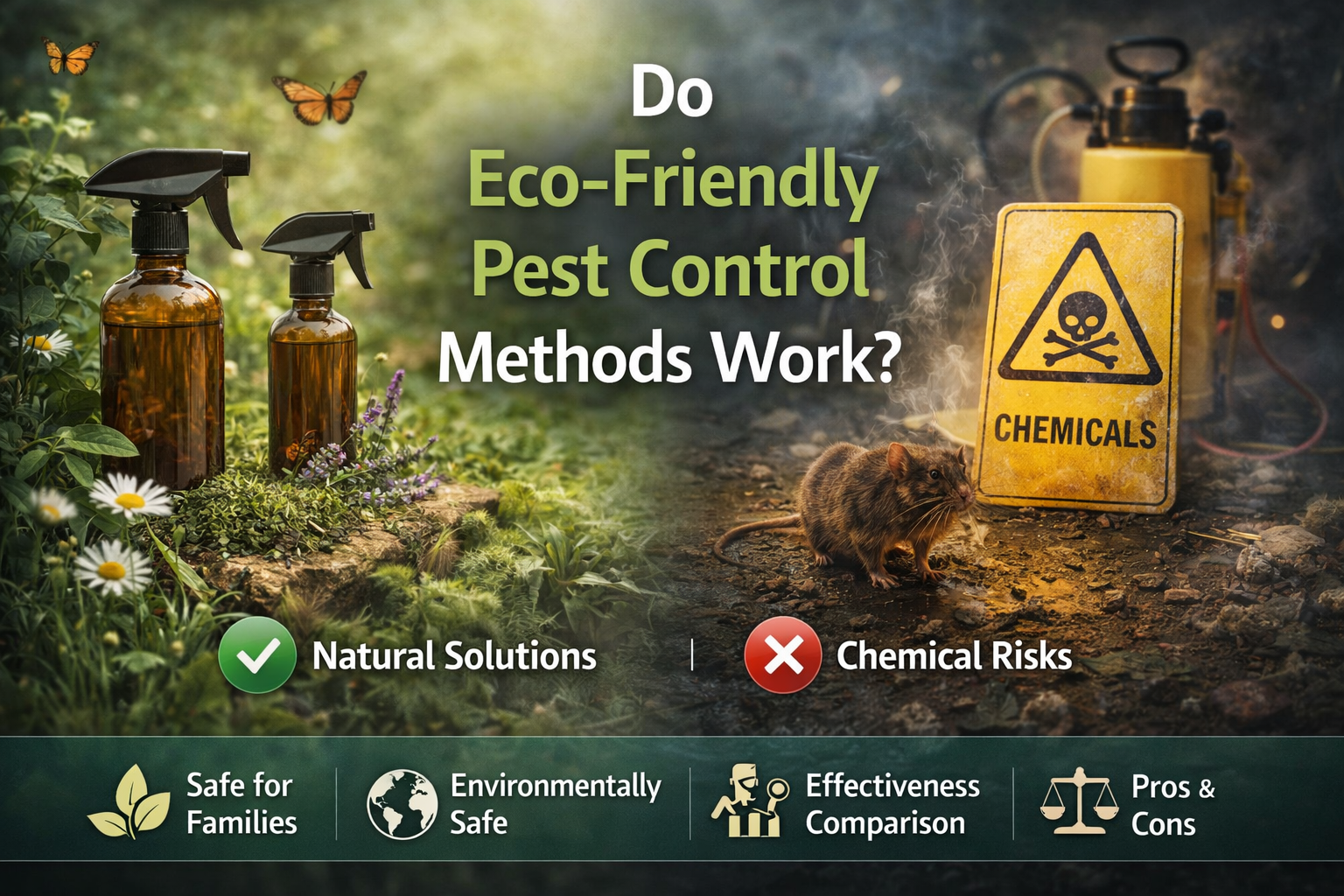
TLDR: Yes, eco-friendly pest control methods genuinely work when applied correctly and consistently. From neem oil and diatomaceous earth to Integrated Pest Management (IPM) and biological controls, natural pest control solutions effectively eliminate common household pests without harming your family, pets, or the environment. For severe infestations, professional green pest control services like those offered by Skuas Pest Control combine these methods for guaranteed, long-lasting results.
Table of Contents
- Why Are People Switching to Eco-Friendly Pest Control?
- Do Eco-Friendly Pest Control Methods Actually Work?
- 7 Proven Eco-Friendly Pest Control Methods
- Eco-Friendly vs. Chemical Pest Control: A Quick Comparison
- When Should You Call a Professional Green Pest Control Service?
- How Skuas Pest Control Delivers Safe Pest Control for Families
- Common Mistakes to Avoid with Natural Pest Control
- FAQs
1. Why Are People Switching to Eco-Friendly Pest Control?
More Indian homeowners and businesses are asking the same question today: "Is there a way to get rid of pests without filling my home with toxic chemicals?"
The answer is yes, and the shift is already happening. Growing awareness about the health risks linked to synthetic pesticides, including respiratory issues, skin irritation, hormonal disruption, and long-term neurological effects, is pushing families toward safer, greener alternatives. Parents with young children, pet owners, and people with allergies are especially concerned about the chemicals used in traditional pest treatments.
Beyond personal health, there is a wider environmental impact to consider. Conventional chemical pesticides can contaminate soil and groundwater, harm beneficial insects like bees and butterflies, and disrupt local ecosystems. Choosing organic pest control for your home is not just about protecting your family, it is a responsible choice for the environment too.
The good news is that science strongly supports the effectiveness of eco-friendly pest control methods. Recent research published in peer-reviewed journals confirms that Integrated Pest Management (IPM) and natural alternatives consistently reduce pest populations while significantly lowering chemical exposure. It is not a trade-off between effectiveness and safety, you can genuinely have both.
2. Do Eco-Friendly Pest Control Methods Actually Work?
This is the core question, and it deserves a direct, honest answer.
Yes, they work. But with important nuances.
Eco-friendly pest control methods are highly effective for prevention, early-stage infestations, and ongoing maintenance. Natural solutions like neem oil, diatomaceous earth, and biological controls have been validated by scientific research and are used successfully by pest management professionals worldwide.
However, effectiveness depends on three key factors:
- Correct identification of the pest species involved
- Proper application of the right method for the right pest
- Consistency, natural methods typically require patience and regular reapplication
For mild to moderate infestations, natural pest control solutions can match or even exceed the results of chemical treatments. For severe or deeply established infestations, such as a large termite colony or a major bed bug outbreak, professional green pest control services that combine multiple eco-friendly approaches under expert supervision deliver the most reliable results.
The critical gap most competitors miss: eco-friendly does not mean slow or weak. When applied correctly, methods like heat treatment for bed bugs or boric acid for cockroaches work faster than many people expect.
3. Seven Proven Eco-Friendly Pest Control Methods
1. Integrated Pest Management (IPM): The Gold Standard
IPM is not a single technique, it is a strategic framework that combines prevention, monitoring, and targeted treatment to manage pests with the lowest possible risk to people and the environment. It is widely recognized by environmental and agricultural bodies as the most responsible approach to pest management available today.
IPM works by first identifying pest thresholds (how much damage is actually unacceptable), then using the least harmful method first and escalating only when necessary. This means physical barriers and habitat modifications come before any chemical application, and when chemicals are used, only targeted, low-toxicity options are chosen.
Best for: Long-term pest prevention in homes, offices, restaurants, and commercial properties.
2. Neem Oil: Nature's Powerful Pesticide
Extracted from the seeds of the neem tree (Azadirachta indica), neem oil is one of the most researched and widely used organic pest control solutions available. Its active compound, azadirachtin, disrupts the hormonal systems of insects, preventing them from feeding, reproducing, and developing normally.
Neem oil is effective against a remarkably wide range of pests including aphids, whiteflies, spider mites, thrips, fungus gnats, and many more. It is biodegradable, breaks down quickly in the environment, and poses minimal risk to beneficial insects when used correctly.
Application tip: Mix neem oil with water and a small amount of liquid soap, then spray directly on affected plants or surfaces. Reapply every 7 to 14 days for best results.
Best for: Garden pests, houseplant pests, and early-stage insect infestations.
3. Diatomaceous Earth: The Silent Pest Destroyer
Diatomaceous earth (DE) is a naturally occurring powder made from the fossilized remains of tiny aquatic organisms called diatoms. It kills insects by physically damaging their exoskeletons and absorbing the waxy coating that prevents them from losing moisture, causing them to dehydrate and die.
DE is completely low-toxicity to humans, pets, and wildlife when food-grade versions are used. It is particularly effective against cockroaches, ants, bed bugs, fleas, and many crawling insects. Because it kills pests through a physical rather than chemical mechanism, pests cannot develop resistance to it, a major advantage over synthetic pesticides.
Application tip: Apply a thin layer in areas where pests travel, along baseboards, under appliances, in wall voids, and around entry points. Reapply after cleaning or if the powder gets wet.
Best for: Cockroaches, ants, bed bugs, fleas, and crawling insects.
4. Biological Control: Using Nature's Own Pest Fighters
Biological control involves using living organisms, natural predators, parasites, or pathogens, to reduce pest populations. This is one of the oldest and most environmentally sustainable eco-friendly pest control methods available.
Examples include introducing Bacillus thuringiensis (Bt), a naturally occurring soil bacterium, to control mosquito larvae and caterpillars. Beneficial nematodes, microscopic roundworms, are effective against soil-dwelling pests like grubs and root maggots. Predatory insects like ladybugs help control aphid populations in gardens.
The advantage of biological control is that it is self-sustaining once established, has no chemical residues, and causes no collateral damage to non-target species when properly implemented.
Best for: Garden pests, mosquito larvae, soil-dwelling pests.
5. Essential Oil Repellents: Aromatic and Effective
Several essential oils have proven pest-repellent properties backed by scientific research. Peppermint oil repels mice, spiders, and ants. Eucalyptus oil deters mosquitoes and flies. Cedar oil kills and repels cockroaches, mosquitoes, and moths. Lavender oil keeps moths, fleas, and flies away.
These natural pest control solutions work best as part of a broader prevention strategy rather than as standalone treatments for active infestations. They are excellent for creating a pest-unfriendly environment in your home, particularly in kitchens, storage areas, and entry points.
Application tip: Dilute with water and spray around entry points, baseboards, and areas where pests are commonly seen. Refresh every few days as the scent fades.
Best for: Prevention, mild infestations, and ongoing maintenance.
6. Physical Barriers and Exclusion: Stop Pests Before They Enter
The most eco-friendly pest control method is also the most often overlooked: keeping pests out in the first place. Physical exclusion involves sealing all gaps, cracks, and entry points through which pests can enter your home or business.
This includes installing door sweeps, sealing gaps around pipes and cables with steel wool or caulk, repairing window screens, and fixing leaking taps that attract pests with moisture. For bird control, professional installation of nets and spikes prevents roosting without harming birds.
Physical barriers require no chemicals whatsoever and, when done thoroughly, provide long-term protection. They are the foundation of any effective natural pest control strategy.
Best for: All pest types, especially rodents, cockroaches, and birds.
7. Heat Treatment: Chemical-Free Elimination for Bed Bugs
Heat treatment is one of the most powerful eco-friendly pest control methods for bed bug infestations. By raising room temperatures to levels lethal to bed bugs at all life stages, including eggs, heat treatment achieves complete elimination without a single drop of pesticide.
Professional heat treatment penetrates deep into mattresses, furniture, and wall voids where bed bugs hide, killing them in places that sprays cannot reach. It is the preferred choice for families with children, elderly residents, and individuals with chemical sensitivities.
Best for: Bed bugs, certain stored-product pests.
4. Eco-Friendly vs. Chemical Pest Control: A Quick Comparison
| Feature | Eco-Friendly Methods | Chemical Pesticides |
|---|---|---|
| Safety for family & pets | ✅ High | ⚠️ Moderate to Low |
| Environmental impact | ✅ Minimal | ❌ Significant |
| Speed of results | ⚠️ Moderate | ✅ Fast |
| Long-term effectiveness | ✅ Excellent | ⚠️ Risk of resistance |
| Pest resistance risk | ✅ Very Low | ❌ High |
| Residue in home | ✅ None or minimal | ❌ Yes |
| Cost over time | ✅ Lower | ❌ Higher |
| Suitable for severe infestations | ⚠️ With professional help | ✅ Yes |
5. When Should You Call a Professional Green Pest Control Service?
DIY eco-friendly pest control methods work well for prevention and mild infestations. But there are specific situations where professional intervention becomes not just beneficial but necessary:
- Severe or widespread infestations that have spread across multiple rooms or areas
- Termite infestations, which require specialized treatment like anti-termite reticulation systems
- Recurring infestations that keep coming back despite DIY treatment
- Commercial properties that must comply with food safety and hygiene regulations
- Bed bug infestations that require professional heat treatment for complete elimination
- Rodent infestations that need expert exclusion work to prevent re-entry
A professional green pest control service has access to commercial-grade eco-friendly products, specialized equipment, and the expertise to select the right combination of methods for your specific pest problem, delivering faster, more reliable results than DIY approaches.
6. How Skuas Pest Control Delivers Safe Pest Control for Families
At Skuas Pest Control, we have made a deliberate commitment to green pest control services that protect both your family and the environment without compromising on effectiveness. We understand that your home is your sanctuary, and the products used to protect it should never threaten the health of the people inside it.
Our approach is built on the principles of Integrated Pest Management (IPM), combining the most effective eco-friendly pest control methods with professional expertise and advanced equipment. Every treatment begins with a thorough inspection to accurately identify the pest, assess infestation severity, and determine the safest, most effective treatment strategy.
We use WHO-approved, low-toxicity products and application methods that minimize chemical exposure while maximizing pest control effectiveness. From gel bait cockroach treatments and heat treatment for bed bugs to biological mosquito control and professional bird net installation, Skuas Pest Control offers a full suite of safe pest control services for families, businesses, and commercial properties.
Our certified technicians are trained to follow the strictest safety protocols, and we provide detailed post-treatment guidelines to help you maintain a pest-free, healthy environment long after our service is complete. Every service comes with a satisfaction guarantee, because we are confident in the effectiveness of our eco-friendly approach.
Whether you need organic pest control for your home, green pest control for your office, or a comprehensive annual pest management contract, Skuas Pest Control delivers professional, responsible, and guaranteed pest control solutions you can trust.
7. Common Mistakes to Avoid with Natural Pest Control
Even the best eco-friendly pest control methods can fail if applied incorrectly. Here are the most common mistakes people make, and how to avoid them:
Expecting overnight results. Natural methods work systematically and may take days to weeks to show full results. Be consistent and patient rather than abandoning the approach too soon.
Using a single method alone. The most effective natural pest control strategy combines multiple methods simultaneously, for example, pairing diatomaceous earth with physical exclusion and essential oil repellents for cockroach control.
Misidentifying the pest. Applying neem oil for a rodent problem or DE for mosquitoes will not work. Correct pest identification is the essential first step of any successful treatment.
Incorrect application. Too little product has no effect; too much can be wasteful. Follow recommended application rates and refresh treatments as directed.
Neglecting the source. Natural repellents work better when you also eliminate the conditions attracting pests, standing water, food crumbs, cluttered storage areas, and entry points.
Skipping professional help for severe cases. For established, large-scale infestations, professional green pest control services are the smart, cost-effective choice.
FAQs
Q1. Are eco-friendly pest control methods as effective as chemical pesticides?
Yes, when correctly applied. For prevention and mild infestations, natural methods are highly effective. For severe cases, professional green pest control services that combine multiple eco-friendly techniques deliver results comparable to, and often better than, conventional chemical treatments, with the added benefit of zero toxic residue.
Q2. How long do eco-friendly pest control treatments last?
This varies by method and pest type. Diatomaceous earth remains effective as long as it stays dry. Neem oil treatments last 7 to 14 days before reapplication. Professional heat treatments for bed bugs provide immediate, one-treatment elimination. Physical exclusion measures last for years when properly maintained.
Q3. Is organic pest control safe for children and pets?
Most natural pest control solutions, particularly food-grade diatomaceous earth, neem oil, essential oil repellents, and biological controls, are very safe for children and pets when used as directed. Always check product labels and follow application guidelines.
Q4. Can eco-friendly methods handle a severe termite infestation?
Severe termite infestations require professional treatment. Methods like anti-termite reticulation systems use government-approved termiticides at minimal quantities targeted precisely at the infestation zone, making them far more environmentally responsible than broad-spectrum chemical spraying.
Q5. What is the most effective eco-friendly method for cockroach control?
Gel bait treatment combined with diatomaceous earth and physical exclusion is the most effective combination. Gel bait is odorless, food-safe, and spreads through the cockroach colony via a cascade effect, eliminating even cockroaches that never directly contact the bait.
Q6. How do I know if an eco-friendly pest control service is genuinely green?
Ask whether they follow IPM principles, what certifications their technicians hold, which specific products they use and whether those products are WHO-approved, and whether they provide a post-treatment service report. A genuinely green pest control company will answer all of these questions transparently.
Q7. Does Skuas Pest Control offer eco-friendly pest control services? Y
es. Skuas Pest Control provides comprehensive green pest control services for homes and businesses using WHO-approved, low-toxicity products and Integrated Pest Management principles. Our services are safe for families, children, and pets while delivering guaranteed pest elimination results.
Final Thoughts
Eco-friendly pest control methods are not just a feel-good alternative to chemicals, they are a scientifically validated, highly effective approach to pest management that protects your family, your home, and the environment simultaneously. The key is choosing the right method for the right pest, applying it correctly, and combining multiple strategies for comprehensive protection.
For professional green pest control services that you can trust to be both effective and genuinely safe, Skuas Pest Control is here to help. Our certified experts use the latest eco-friendly techniques and WHO-approved products to eliminate pests from your home or business, with guaranteed results and zero compromise on your family's safety.
Contact Skuas Pest Control today for a free inspection and experience the difference that responsible, professional, eco-friendly pest control makes.
Disclaimer: Results may vary depending on the type and severity of pest infestation. Professional inspection is recommended before treatment. Skuas Pest Control uses government-approved products and follows all applicable safety guidelines.