
- Which pests are most common in Delhi?
- Does pest season change with the weather?
- DIY vs professional pest control, when does it matter?
- What types of treatments are used?
- Is pest control safe for children and pets?
- How often should a home be treated?
- Termite-specific questions
- What does pest control typically cost in Delhi?
- How do people choose a pest control service?
- Quick FAQ
Which pests are most common in Delhi?
Delhi's climate, hot summers, a humid monsoon season, and mild winters, supports a wide variety of pests throughout the year. The most frequently reported include:
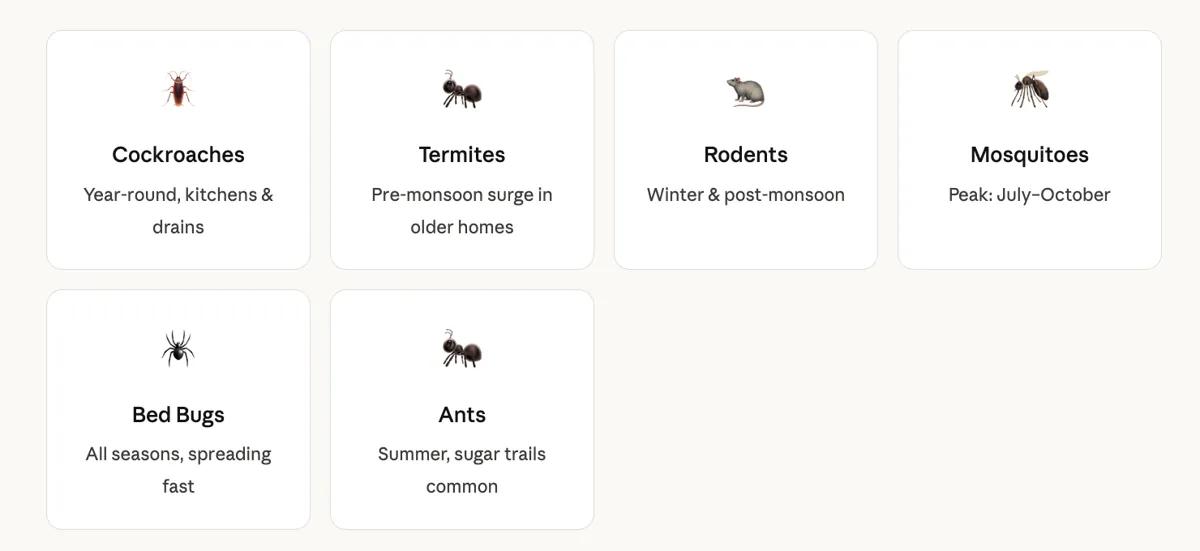
Cockroaches top the list across most surveys. German and American cockroaches both thrive in Delhi's warm, moist drains and kitchen corners. Termites are the next biggest concern for homeowners, particularly in older constructions where wooden beams and frames are at risk.
Bed bugs have increased significantly over the last five to seven years, partly due to higher travel frequency and second-hand furniture transactions. Unlike mosquitoes or ants, bed bugs are not seasonal, they remain active year-round.
Does pest activity change with the weather?
Yes, significantly. Delhi's four distinct seasons each bring a different set of pest pressures:
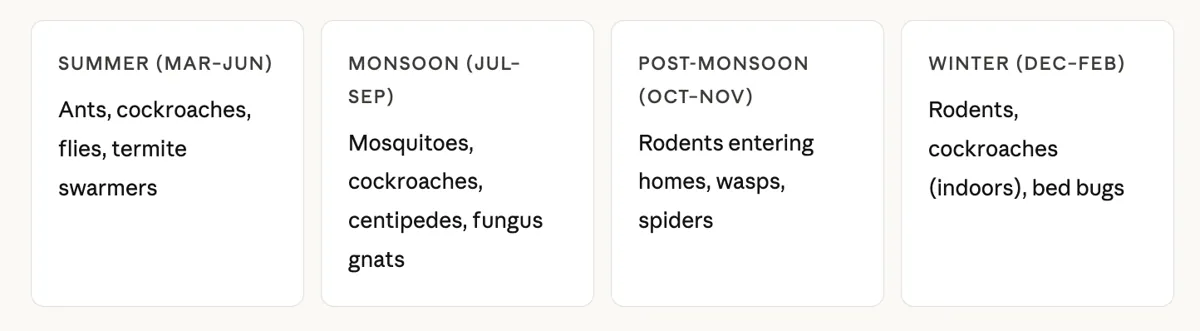
The monsoon is often cited as the most challenging period. Standing water, even small amounts in pots, cooler trays, or drainage gaps, can become a mosquito breeding site within three to five days. At the same time, moisture seeping into walls and wooden furniture accelerates termite activity.
A pre-monsoon treatment (typically late May or June) is widely recommended in Delhi to address termites and cockroaches before humidity peaks. Post-monsoon rodent control in October to November helps prevent winter infestations.
DIY vs professional pest control: when does it matter?
When DIY can work
For very minor or early-stage infestations, over-the-counter sprays, gel baits, and glue traps can be effective. A handful of ants or the occasional cockroach sighting does not necessarily require professional intervention if the source is found and addressed.
When professional treatment is necessary
Professional treatment becomes necessary in several situations:
- Termite infestation in walls, furniture, or flooring, DIY products rarely penetrate deep enough into wood or soil to eliminate a colony
- Recurring cockroach or bed bug problems that return within weeks of DIY treatment
- Rodent colonies rather than isolated sightings, requires baiting strategy and entry-point sealing
- New construction or renovation, pre-construction anti-termite treatment is mandatory in many municipal norms
- Large or multi-unit properties (apartments, offices) where treatment must cover common areas and multiple units simultaneously
Misuse of over-the-counter pesticides is a documented health risk. Products meant for outdoor use are sometimes applied indoors at incorrect concentrations. Always read label instructions, or opt for a licensed professional when in doubt.
What types of treatments are used?
Pest control methods have evolved considerably. In Delhi, the following are most commonly used by licensed operators:
Gel baiting
Used mainly for cockroaches and ants. A small amount of insecticidal gel is placed in cracks, corners, and under appliances. Pests ingest the bait and carry it back to the colony. This method is odourless, requires no evacuation, and is considered low-risk for humans and pets when applied correctly.
Chemical spray treatments
Water-based or oil-based pesticides are sprayed in identified areas. Older formulations had strong odours; newer water-based sprays are significantly less pungent. These are used for general pest control including cockroaches, ants, and occasional invaders. Residents are generally advised to vacate for two to four hours after treatment.
Fumigation
Fumigation involves sealing a structure and releasing gas-phase pesticides. It is used for severe infestations, stored grain treatment, or shipping containers. Full-home fumigation is less common for residential Delhi properties but is used for serious termite or bed bug cases.
Soil treatment for termites
A liquid termiticide is injected into the soil around the foundation and within wall cavities. This creates a treated zone that termites cannot cross. It is the most common method for subterranean termite control in Delhi.
Heat treatment
Increasingly used for bed bug elimination. The room or furniture is raised to temperatures above 50°C, which kills all life stages of bed bugs without chemicals. It is more expensive but leaves no chemical residue.
Is pest control safe for children and pets?
This is consistently one of the top searched questions in Delhi. The answer depends on the method and the product used, but with proper precautions, professional pest control is generally safe.
Standard precautions that licensed operators follow
- Children and pets are asked to leave the treated area for two to four hours after spray-based treatments
- Food, water bowls, and utensils are covered or moved before treatment
- Gel baiting, which is placed in enclosed spots, does not require evacuation and is considered the safest option for homes with infants or pets
- Fish tanks are covered and filters turned off during any spray-based treatment
- After treatment, surfaces that children or pets contact frequently (floors, low counters) are wiped down before reoccupying
It is always reasonable to ask the pest control operator what specific product they are using, its active ingredient, and the recommended re-entry time. A legitimate operator should be able to provide this information and a copy of the safety data sheet (SDS) on request.
In India, pest control products used commercially must be registered with the Central Insecticides Board and Registration Committee (CIBRC). Choosing a licensed operator reduces the risk of exposure to unregistered or sub-standard chemicals.
How often should a home be treated?
There is no universal answer, it depends on the property type, history of infestation, and surrounding environment. That said, some general patterns hold for most Delhi homes:
- General pest control (cockroaches, ants, common insects): once every three to six months for preventive maintenance; monthly for active infestations until resolved
- Mosquito control: monthly during and immediately after monsoon season (July to October)
- Termite treatment: anti-termite soil treatment typically has a guarantee period of five to ten years, but annual inspections are advisable
- Rodent control: ongoing monitoring traps with periodic bait refreshes; address entry points permanently
- Bed bugs: heat or chemical treatment followed by a follow-up inspection at two weeks and thirty days
Homes near drains, markets, or construction sites may require more frequent attention than ground-floor-isolated residential units.
Termite-specific questions
How do I know if I have termites?
The most visible signs are mud tubes along walls, hollow-sounding wood when tapped, discarded wings near windows during swarming season (typically April to June in Delhi), and paint that appears to bubble without moisture. Termite damage can go undetected for years because colonies work from the inside out.
What is the difference between subterranean and drywood termites?
Subterranean termites live in soil and travel up through mud tunnels to reach wood. They are the most destructive and most common variety in North India. Drywood termites nest within the wood they eat, are smaller colonies, and are found more often in furniture than in structural wood. Treatment methods differ between the two.
Can termites be fully eliminated?
A colony can be eliminated or driven out, but in Delhi's environment, where soil-dwelling subterranean termites are widespread, re-infestation is possible over time. This is why periodic inspections and maintaining the treated zone around foundations matter more than a one-time treatment.
Should anti-termite treatment be done before or after construction?
Pre-construction soil treatment is the most effective method and is part of building regulations in many municipal areas. It involves treating the soil at foundation level before the concrete is poured, creating a chemical barrier. Post-construction treatment (drilling and injecting termiticide) is less thorough but necessary when construction-stage treatment was missed.
What does pest control typically cost in Delhi?
Pricing varies by service type, property size, and provider. The following are approximate market ranges as of 2025 to 2026 for standard Delhi residential properties:
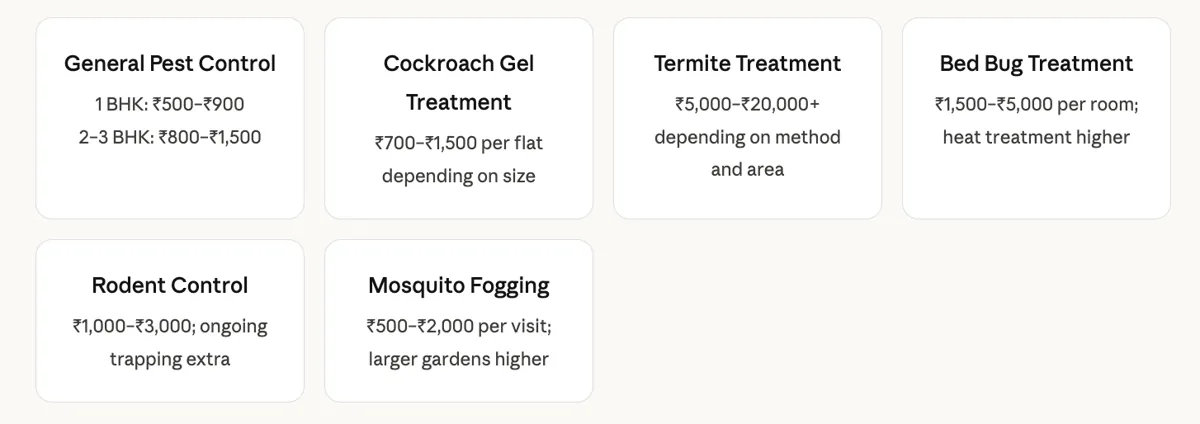
AMC (Annual Maintenance Contract) packages, which bundle multiple visits across the year, often offer better value than one-off treatments for properties with recurring problems. Prices for AMCs in Delhi typically range from ₹2,000 to ₹8,000 per year for a standard 2 to 3 BHK, depending on the scope.
Extremely low quotes (e.g., ₹200, ₹300 for a full apartment treatment) are a common red flag. They often indicate unlicensed operators using diluted or unregistered chemicals. Always ask for a company registration certificate and a list of chemicals to be used.
How do people choose a pest control service in Delhi?
With hundreds of operators in the city, selecting a trustworthy service can be overwhelming. The following criteria are commonly used by informed consumers:
- Licensing: the operator should hold a valid Pest Control Operator's license under the Insecticides Act, 1968
- Technician training: ask whether technicians are certified; good operators invest in regular product and safety training
- Transparency: a reliable company will explain exactly which products will be used, their active ingredients, and the expected result timeline
- Written guarantee: most reputable providers offer a re-treatment guarantee if the pest returns within the agreed period (typically 30 to 90 days)
- Reviews and references: check Google reviews and ask for references in the same locality, pest pressures can differ significantly between colonies and building types
- Inspection before quoting: a professional service will typically assess the property before giving a quote; an immediate flat-rate quote without a site visit is a warning sign for complex problems like termites
Skuas Pest Control is a Delhi-based pest management company. Like other operators in this space, they offer services covering termite control, cockroach treatment, rodent management, mosquito control, and general pest treatments for residential and commercial properties. When evaluating any provider, including Skuas Pest Control, applying the criteria above (licensing, transparency, guarantee policy) is a sound starting point.
Quick FAQ
Pest control decisions benefit most from accurate information, about the specific pest, the building environment, and the treatment options available. This guide reflects general best practices and common knowledge; always confirm specifics with a licensed professional for your property's particular situation.