
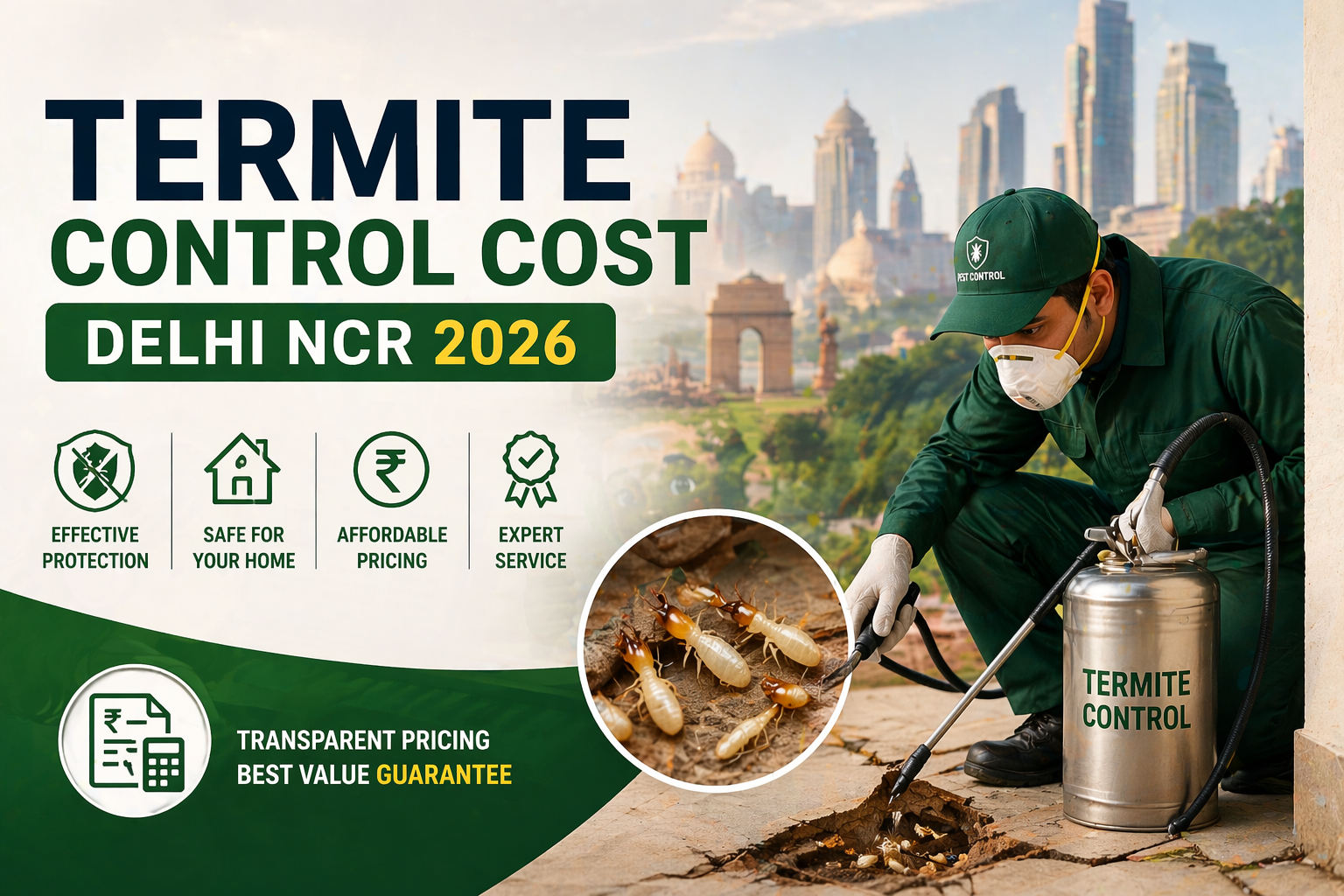
Updated pricing for every treatment method, property size, and area — with ROI analysis, seasonal discounts, and expert guidance from 12+ years of Delhi NCR field experience.
Reading time: ~16 min Updated: April 2026 By Skuas Pest Control Experts
12+ Years Delhi NCR Experience 2,500+ Projects Completed CIBRC-Certified Chemicals Transparent Pricing No Hidden Charges
🛡️
Skuas Pest Control — Certified Termite Specialists
This guide is compiled by our licensed termite control team with 12+ years of Delhi NCR market experience and 2,500+ residential and commercial projects. All pricing reflects April 2026 market data.
Table of Contents
- Pricing Overview 2026
- What Changed from 2025
- Cost by Treatment Method
- Square Foot Pricing Matrix
- Factors Affecting Cost
- Area-Wise Pricing in Delhi NCR
- Budget vs Standard vs Premium
- Hidden Costs to Watch
- ROI & Long-Term Savings
- DIY vs Professional Cost
- Seasonal Pricing & Best Time
- How to Get Best Value
- AQs About Cost
- Conclusion
01 · Pricing Overview
Termite Control Costs in Delhi NCR — 2026 Market Update
Termite control costs in Delhi NCR in 2026 reflect a market shaped by rising chemical input costs, stronger regulatory enforcement, and a growing shift toward eco-friendly and technology-integrated treatments. Informed customers who understand the pricing landscape continue to achieve significantly better value — both in cost and in the quality of protection they receive.
"Choosing the right termite treatment is not just about the lowest quote — it is about protecting a property worth lakhs or crores against damage that builds silently over years."
Emergency Spot
₹6–10/sq ft
Basic active infestation control
Standard DFS
₹9–16/sq ft
Post-construction protection
Comprehensive
₹14–22/sq ft
Full property + soil barrier
Pre-Construction
₹7–13/sq ft
Foundation-stage treatment
Reticulation System
₹17–28/sq ft
Premium underground network
Commercial
₹20–38/sq ft
Industrial-grade compliance
⚠ 2026 Pricing Note
Prices have increased 10–15% from 2025 due to chemical import costs rising with global supply chain shifts, updated CIBRC compliance requirements, and increases in technician certification standards. Prices below ₹5/sq ft in 2026 are a reliable indicator of substandard chemicals or unlicensed operators.
02 · 2026 Update
What Has Changed from 2025 — Key Updates
If you are working from last year's research, several factors have shifted the termite control market in Delhi NCR in 2026.
📈
Chemical Cost Increase
Import-dependent termiticides saw a 12–18% price increase in late 2025, now reflected in 2026 service quotes across all providers.
📋
Stricter CIBRC Rules
Updated CIBRC registration criteria in 2025–26 removed several older, cheaper chemical formulations from the approved list, narrowing the gap between budget and premium services.
🌿
Eco-Friendly Demand Surge
Requests for low-toxicity, herbal, and child/pet-safe formulations have doubled since 2024. Most professional operators now offer these options at a 15–25% premium.
📡
IoT Monitoring Adoption
Smart pest monitoring systems for commercial properties are now more affordable and widely available, with prices dropping 20% from 2025 as adoption increased.
🏗️
New Construction Surge
Greater Noida, Gurugram, and Dwarka Expressway's construction boom has increased pre-construction treatment demand — and created more competitive pricing in those zones.
📱
App-Based Service Growth
Platform-based booking services have grown but continue to show inconsistent technician quality — a known trade-off with aggregator models versus dedicated local operators.
03 · By Treatment Method
Complete Cost Breakdown by Treatment Method
Emergency Spot Treatment
₹6–10 per sq ft
Targeted application to areas of active termite activity. Effective for immediate control of specific furniture, door frames, or a localized wall section. Not a whole-property solution.
Best For
Active infestation, single items, urgent control
Timeline
2–5 hours
Warranty
6 months (treated area only)
Eco-Friendly Option
Available on request
Up to 800 sq ft₹5,000–8,500
800–1,500 sq ft₹8,000–14,000
1,500–2,500 sq ft₹11,000–22,000
Standard Drill-Fill-Seal (DFS) Treatment
₹9–16 per sq ft
The most common post-construction method. Holes are drilled at skirting level at 12-inch intervals, termiticide is injected into wall cavities and foundation, and holes are sealed. Suitable for the majority of residential properties in Delhi NCR.
Best For
Existing residential properties
Timeline
1–2 days
Warranty
1–3 years with annual inspection
Chemical Standard
CIBRC-registered only
1 BHK (~600 sq ft)₹5,500–10,000
2 BHK (~1,000 sq ft)₹9,000–16,000
3 BHK (~1,500 sq ft)₹14,000–24,000
4 BHK/Villa (~2,500 sq ft)₹23,000–40,000
Comprehensive Protection System
₹14–22 per sq ft
Combines DFS treatment with full perimeter soil treatment, wooden structure treatment, and enhanced chemical concentration. The most thorough post-construction option for high-value properties or high-risk zones. Includes 2–4 year warranty with maintenance.
Best For
High-value homes, repeat infestation, high-risk areas
Timeline
2–4 days
Warranty
2–4 years with maintenance
Coverage
Complete property + soil barrier
1,000 sq ft₹14,000–22,000
2,000 sq ft₹28,000–44,000
3,500 sq ft₹50,000–78,000
Pre-Construction Soil Treatment
₹7–13 per sq ft
Applied at foundation stage before the concrete slab is poured. This is the single most cost-effective termite protection method — creating a chemical barrier in the soil that is 40–60% cheaper than equivalent post-construction protection and significantly more effective over time.
Best For
New construction — must be done at foundation stage
Timeline
2–4 days during construction
Warranty
5–10 years
Effectiveness
95–98% (vs 70–85% post-construction)
1,000 sq ft₹7,000–13,000
2,000 sq ft₹14,000–26,000
3,500 sq ft₹25,000–46,000
Anti-Termite Reticulation System
₹17–28 per sq ft
A network of underground pipes is installed during construction, with access points for periodic chemical replenishment without drilling or disruption. Uses German-origin technology and BIS-certified systems. The gold standard for long-term termite protection in premium new construction.
Best For
Premium new construction, properties above ₹1.5 Cr
Timeline
4–6 days during construction
Warranty
5–10 years with quarterly maintenance
Maintenance
Chemical replenishment via access points — no drilling
1,500 sq ft₹25,000–42,000
2,500 sq ft₹42,000–70,000
4,000 sq ft₹68,000–1,12,000
Commercial & Industrial Solutions
₹20–38 per sq ft
Specialised treatment for offices, restaurants, warehouses, hospitals, and manufacturing units. Includes regulatory compliance documentation, food-safe or medical-grade chemical protocols, business continuity planning, and extended warranties with priority emergency response.
Best For
All commercial & industrial properties
Compliance
FSSAI, BIS, industry-specific standards
Warranty
3–7 years with SLA-based support
Disruption
Minimal — after-hours treatment available
Office 3,000 sq ft₹60,000–1,14,000
Restaurant 2,000 sq ft₹40,000–76,000
Warehouse 10,000 sq ft₹2,00,000–3,80,000
04 · Pricing Matrix
Residential Property Pricing Matrix (2026)
| Property SizeEmergency SpotStandard DFSComprehensivePre-ConstructionReticulation | |||||
| Up to 800 sq ft | ₹5,000–8,500 | ₹7,500–13,000 | ₹12,000–18,000 | ₹5,500–10,500 | ₹14,000–23,000 |
| 800–1,500 sq ft | ₹8,000–15,000 | ₹12,000–24,000 | ₹18,000–33,000 | ₹10,000–20,000 | ₹22,000–42,000 |
| 1,500–2,500 sq ft | ₹12,000–22,000 | ₹18,000–38,000 | ₹28,000–55,000 | ₹15,000–32,000 | ₹34,000–70,000 |
| 2,500–4,000 sq ft | ₹18,000–35,000 | ₹26,000–56,000 | ₹42,000–88,000 | ₹22,000–52,000 | ₹54,000–1,12,000 |
| Above 4,000 sq ft | ₹28,000+ | ₹40,000+ | ₹68,000+ | ₹36,000+ | ₹80,000+ |
Commercial Property Pricing (2026)
| Property TypeSize RangeCost RangeSpecial Requirement | |||
| Small Office | 1,000–3,000 sq ft | ₹20,000–60,000 | Business-hour coordination |
| Restaurant / Retail | 1,500–4,000 sq ft | ₹30,000–90,000 | FSSAI-safe chemicals mandatory |
| IT Office / Tech Park | 3,000–10,000 sq ft | ₹65,000–2,20,000 | Equipment-safe formulations |
| Warehouse / Industrial | 5,000–20,000 sq ft | ₹1,00,000–4,20,000 | Industrial-grade, volume discount |
| Hospital / Clinic | 2,000–8,000 sq ft | ₹44,000–1,80,000 | Medical-grade safety protocols |
Volume Discount Structure
Single property: standard pricing | 2–3 properties: 8–12% off | 4–10 properties: 15–20% off | 10+ properties / builder: 20–25% off | Housing society (entire complex): 25–32% off
05 · Cost Factors
Factors That Affect Termite Control Costs
Understanding these factors helps you benchmark quotes and have informed conversations with any service provider before committing.
Building Age & Construction Type
- New construction (0–3 years): 10–15% lower cost due to easier access and undisturbed soil
- Existing properties (3–12 years): Standard pricing; DFS is most common
- Old buildings (12+ years): 15–30% higher due to access challenges, potential structural complexity, and higher infestation probability
- Heritage/pre-independence structures: 20–40% premium for specialist techniques and heritage-compatible formulations
Infestation Severity
- No active infestation (preventive): Standard pricing, fastest application, full coverage
- Mild infestation (early detection): 10–18% additional for enhanced chemical concentration
- Moderate infestation (visible damage): 20–35% premium for intensive multi-stage treatment
- Severe infestation (structural damage): 35–55% additional; includes emergency protocols and structural coordination
Foundation & Structure Complexity
- Slab foundation: Standard pricing — straightforward treatment access
- Basement/underground: 20–35% additional for extended coverage and chemical volume
- Multi-storey buildings: 10–18% per additional floor above ground level
- Complex or irregular architecture: 15–28% premium for difficult access areas
Geographic & Accessibility Factors
- Easy road access: Standard pricing
- Narrow lanes / gali-access only: ₹1,000–3,500 additional for equipment handling
- High-rise buildings (above 4th floor): 15–28% premium for access equipment and logistics
- Areas beyond 25 km from service centre: ₹1,000–5,000 logistics surcharge
Timing & Urgency
- Planned/scheduled treatment: Standard pricing
- Urgent / same-week service: 25–45% premium during peak seasons
- Weekend / public holiday service: 20–35% additional charges
- After-hours commercial treatment: 30–55% premium for business continuity
06 · Area-Wise Pricing
Delhi NCR Area-Wise Pricing Variations (2026)
Service pricing across Delhi NCR is not uniform. Property values, traffic logistics, technician availability, and local competition all influence what you will pay in a specific area.
Premium Areas (+20–40%)
Vasant Kunj · Greater Kailash · Defence Colony · Hauz Khas · Safdarjung · Green Park · DLF Phases · Golf Course Road · Cyber City Gurugram
Typical: ₹8–38/sq ft across methods
Standard Areas (Base Rate)
Noida Sectors · Greater Noida · Connaught Place · Karol Bagh · Lajpat Nagar · Khan Market · South Extension · Vasant Vihar
Typical: ₹6–28/sq ft across methods
Competitive Areas (−10–20%)
Laxmi Nagar · Preet Vihar · Mayur Vihar · Janakpuri · Rajouri Garden · Punjabi Bagh · Faridabad · Ghaziabad · Dwarka
Typical: ₹5–22/sq ft across methods
Special Area Considerations
- Heritage areas (Old Delhi, Civil Lines): 18–30% premium for heritage-compatible techniques and documentation requirements
- High-security zones (Diplomatic Enclave, VIP areas): 12–22% premium for security clearance, scheduling coordination, and documentation
- New development corridors (Greater Noida West, Dwarka Expressway): Competitive standard rates; volume discounts common due to high construction activity
- Non-metro accessible areas: 5–12% logistics surcharge; always confirm transportation costs upfront
07 · Solution Tiers
Budget vs Standard vs Premium vs Commercial
Tier 1
Budget Protection
₹6–10/sq ft
- Emergency spot or basic spray treatment
- 6–12 month effectiveness
- Limited warranty (treated area only)
- Standard technicians
- Best for: rental properties, urgent situations, temporary solution
Best Value
Tier 2
Standard Protection
₹9–18/sq ft
- Complete drill-fill-seal treatment
- 2–3 year effectiveness
- Comprehensive property warranty
- Certified technicians with experience
- Best for: family homes, standard residential properties
Tier 3
Premium Protection
₹17–28/sq ft
- Reticulation system or comprehensive treatment
- 5–10 year effectiveness
- Extended warranty + maintenance included
- Specialist technicians; German technology
- Best for: high-value properties, new construction
Tier 4
Commercial Grade
₹20–38/sq ft
- Industry-specific treatment protocols
- 3–7 year SLA-backed warranty
- Regulatory compliance documentation
- Business continuity planning
- Best for: offices, restaurants, warehouses, hospitals
Expert recommendation: For most Delhi NCR homeowners, Tier 2 (Standard Protection) provides the best cost-to-protection ratio. Tier 3 is worth the additional investment for properties above ₹1 crore in value or those in high-risk termite zones near water bodies, green belts, or older neighbouring structures.
08 · Hidden Costs
Hidden Costs & Additional Charges to Watch For
Transparency is one of the most important factors when selecting a termite control provider. Here is what you should expect to be included, what might legitimately cost extra, and what are red flags.
What Should Be Included in Every Base Quote
- Site inspection and treatment planning — a reputable provider does not charge separately for pre-booking assessment
- All chemicals and materials — hole sealing, protective coverings, and application equipment
- Professional application by CIBRC-licensed technicians using registered products
- Basic warranty covering at minimum 1 year with re-treatment provision
- Post-treatment documentation — completion certificate with product details and application record
- 30-day follow-up inspection to verify treatment effectiveness
Legitimate Additional Charges
- Difficult access surcharge: ₹1,000–3,500 for narrow lanes, high-rises above 5th floor, or remote locations
- Emergency/urgent service premium: 25–45% for same-week or weekend requests during peak season
- Extended warranty: ₹3,000–15,000 for warranty beyond the standard period
- Eco-friendly or odourless chemical upgrade: ₹2,000–6,000 depending on property size
- Annual maintenance contract: ₹4,000–14,000/year for ongoing monitoring and chemical replenishment
- Compliance documentation: ₹1,000–5,000 for commercial regulatory certificates
Red Flags — Warning Signs of Unreliable Providers
🚩 Avoid These
Quotes significantly below market: Anything below ₹5/sq ft in 2026 indicates diluted chemicals, unlicensed operators, or severely reduced coverage.
Cash-only payment with no receipt: Legitimate operators provide invoices and accept digital payments.
No written scope of work: Verbal-only quotes with vague terms are a reliable indicator of disputes later.
Inability to name the chemical being used: Every operator must be able to provide the product name, active ingredient, and CIBRC registration number.
Warranty with excessive exclusions: If the warranty document has more exclusions than coverage, it offers no real protection.
09 · ROI Analysis
Return on Investment & Long-Term Savings Calculator
Typical Termite Damage Costs in Delhi NCR (Without Protection)
| Damage TypeLow EstimateHigh EstimateAverage | |||
| Wooden Flooring | ₹2,00,000 | ₹9,00,000 | ₹4,50,000 |
| Kitchen Cabinets | ₹1,50,000 | ₹6,00,000 | ₹2,80,000 |
| Doors & Windows | ₹1,00,000 | ₹4,00,000 | ₹2,00,000 |
| Furniture | ₹60,000 | ₹3,00,000 | ₹1,40,000 |
| Structural Beams/Joists | ₹3,50,000 | ₹18,00,000 | ₹8,50,000 |
| Total Potential Damage | ₹8,60,000 | ₹40,00,000 | ₹19,20,000 |
15-Year Cost Scenario Comparison (2,000 sq ft property)
Scenario 1
No Protection
₹16,32,000
85% damage probability over 15 years (₹19.2L avg × 0.85)
Scenario 2
Budget Treatment (Re-applied every 2 yrs)
₹8,60,000
₹1,10,000 treatments + ₹7,50,000 residual damage risk (40%)
Saves ₹7,72,000 vs no protection
Scenario 3
Standard Comprehensive (Re-applied every 4 yrs)
₹3,68,000
₹80,000 treatments + ₹2,88,000 residual risk (15%)
Saves ₹12,64,000 vs no protection
Scenario 4
Premium Reticulation System
₹1,10,000
₹72,000 installation + ₹24,000 maintenance + ₹14,000 residual (2% risk)
Saves ₹15,22,000 vs no protection — best long-term ROI
Property Value Enhancement
- Resale value increase: 3–7% for properties with certified, documented termite protection (₹3–7 lakhs on a ₹1 Cr property)
- Property insurance savings: 10–15% annual premium reduction with certified protection
- Rental premium: Protected properties typically command 5–10% higher rent and attract longer-tenure tenants
- Faster sale/lease: Documented protection reduces due diligence concerns and speeds transaction timelines by an estimated 20–30%
10 · DIY vs Professional
DIY Termite Treatment vs Professional Service — Real Cost Comparison
DIY termite treatment options are available at hardware stores and online. The honest assessment is that for small, very early-stage and surface-level problems, they can provide temporary relief. For any established infestation or whole-property protection need, professional treatment consistently delivers better value over a 5-year horizon.
DIY Limitations
- Treats visible symptoms, not source colony
- Consumer chemicals are significantly weaker than professional-grade
- Cannot inject into wall cavities without professional equipment
- 20–40% success rate vs 85–98% professional
- No warranty — complete re-treatment at own cost if it fails
- Risk of chemical exposure without proper PPE
- Egg cases and larvae frequently survive surface sprays
Professional Advantages
- Inspection identifies root cause and infestation extent
- CIBRC-registered chemicals at professional concentration
- Precision injection into cavities, foundations, and soil
- Warranty covers free re-treatment if termites return
- Proper PPE, disposal, and documentation included
- Preventive advice reduces re-infestation risk
- Single investment vs repeated DIY expenses
5-Year Real Cost Comparison (2,000 sq ft property)
| Cost ElementDIY ApproachProfessional (Standard) | ||
| Initial treatment | ₹10,000–20,000 (including equipment, safety gear, chemicals) | ₹18,000–34,000 |
| Re-treatments (DIY fails ~60% within 18 months) | ₹8,000–15,000 × 3 = ₹24,000–45,000 | ₹0 (warranty covered) |
| Property damage risk (DIY: 50% probability) | ₹9,60,000 expected damage | ₹2,88,000 expected damage (15%) |
| Total 5-Year Expected Cost | ₹9,94,000–10,25,000 | ₹20,880–36,880 |
When DIY is reasonable: A single piece of furniture, one isolated door frame, or very early detection in a small area — combined with a professional inspection to confirm the infestation has not spread. DIY should always be a bridge to professional treatment, not a replacement for it.
11 · Seasonal Pricing
Seasonal Pricing Trends & Best Time to Book
In Delhi NCR, termite treatment pricing and effectiveness both vary with the season. The ideal time to treat is when chemical penetration is optimal and demand is moderate.
Oct – Dec (Prime)
Demand: High
Pricing: Standard
Best chemical effectiveness and curing. Book 2–3 weeks in advance.
Jan – Mar (Excellent)
Demand: Moderate–High
Pricing: Standard; early-bird for next season
Good availability. Peak construction treatment window.
Apr – May (Pre-monsoon)
Demand: Moderate
Pricing: Standard to promotional
Pre-monsoon urgency. Enhanced safety for heat. Good results with proper protocol.
Jun – Sep (Budget Season)
Demand: Lowest
Pricing: 12–25% discount
Maximum savings but weather-dependent. Best for non-urgent, interior-only treatments.
Cost Optimization Strategies
- Off-season booking (Jun–Aug): Save 12–25%; best for interior treatments where monsoon does not affect application quality
- Early-bird pre-season (book Oct treatment in Aug): 10–15% discount from many providers for advance scheduling
- Multi-year maintenance contracts: Lock in current rates for 3–5 years and save 20–28%
- Weekday scheduling (Mon–Thu): 5–10% discount vs weekend appointments with most providers
- Society/group booking: Coordinate with neighbours or RWA for 25–32% savings on combined treatment
Best Value Month in 2026
For a balance of treatment effectiveness and pricing, November 2026 offers the best conditions — optimal weather for chemical penetration, good technician availability before the December rush, and standard pricing without peak-season premiums. For maximum discounts, July–August 2026 offers the lowest rates with proper interior-focused treatment protocols.
12 · Smart Buying
How to Get the Best Value for Money
Verification Checklist Before Booking Any Provider
- License verification: Ask for the Pest Control Operator's license under the Insecticides Act, 1968. Verify the CIBRC registration of the operator.
- Chemical specification: Request the exact product name, active ingredient, and CIBRC registration number. This is non-negotiable.
- Written scope of work: Ensure the quotation specifies exact treatment method, coverage area, chemical to be used, and application protocol.
- Warranty terms: Read warranty conditions carefully. Confirm what triggers a re-treatment, how to claim, and whether it is free of charge.
- Google reviews: Prioritize reviews that describe specific treatments, technician names, or re-treatment experiences — these are genuine.
- Site inspection before quote: Any provider quoting without inspecting the property is guessing. Professional quotes require on-site assessment.
- References in same locality: Ask for 2–3 recent customers in your area or building type. Pest pressures vary locally.
Effective Negotiation Points
- Ask for volume or society-rate pricing even for individual bookings if you can connect neighbours
- Request an extended warranty at current treatment pricing — often granted for longer-term relationship potential
- Offer scheduling flexibility (weekday, off-peak hours) in exchange for a pricing concession
- Enquire about off-season pricing for non-urgent treatments
- Ask about multi-year AMC pricing locked at current rates
Skuas Pest Control — Pricing Approach
At Skuas Pest Control, every quote follows an on-site inspection. Pricing is fully itemised — treatment method, product used, warranty period, and any applicable surcharges are disclosed in writing before booking. No mandatory add-ons, no surprise charges on the day of treatment. AMC options are available for all property types.
13 · People Also Ask
Frequently Asked Questions About Termite Control Costs
What is the most cost-effective termite treatment for a 2,000 sq ft house in Delhi NCR in 2026?
For a 2,000 sq ft existing home, standard comprehensive drill-fill-seal treatment at ₹18,000–34,000 offers the best balance of cost and protection, with a 2–3 year warranty. If the property is in a high-risk zone (near green belt, water body, or older building) or valued above ₹1 crore, the anti-termite reticulation system at ₹34,000–50,000 delivers better 15-year ROI despite the higher upfront cost.
How much has termite control pricing increased from 2025 to 2026?
Prices in Delhi NCR have increased 10–15% from 2025 levels. The primary drivers are chemical import cost increases of 12–18% (particularly for imidacloprid-based and fipronil-based termiticides), updated CIBRC compliance costs, and labour cost adjustments. The floor for legitimate licensed treatment has risen from ₹5/sq ft to approximately ₹6/sq ft for basic spot treatment.
Is pre-construction termite treatment always cheaper than post-construction?
Yes — typically 40–60% cheaper for equivalent long-term protection. Pre-construction soil treatment at ₹7–13/sq ft with a 5–10 year warranty compares favourably to post-construction DFS at ₹9–16/sq ft with a 1–3 year warranty. More importantly, pre-construction achieves 95–98% effectiveness compared to 70–85% for post-construction methods. If you are in the process of building, this is the single most valuable termite control decision you will make.
Are there any hidden charges I should watch out for?
With reputable providers, no. A professional quote should include all chemicals, application, hole sealing, basic documentation, and a 30-day follow-up. Legitimate additional charges include difficult access surcharges (₹1,000–3,500), emergency service premiums (25–45%), and extended warranty add-ons. Red flags include quotes that arrive without a site visit, vague warranty exclusions, and any pressure to pay the full amount in cash upfront.
How much can a housing society save by booking as a group?
Society-wide or group bookings typically yield 25–32% savings compared to individual apartment bookings. The savings come from reduced technician logistics, bulk chemical procurement, and efficient scheduling. For a 50-unit society with 1,000 sq ft per flat, this can translate to total savings of ₹2–5 lakhs on a complete complex treatment. Coordinating through the RWA is the most effective route.
What warranty should I expect with standard termite treatment in 2026?
Standard DFS treatment should come with a minimum 1-year warranty, with reputable operators offering 2–3 years. Comprehensive treatment warrants 2–4 years. Reticulation systems carry 5–10 year warranties. Any warranty should specify: what triggers a re-treatment claim, the timeline for response (ideally 24–48 hours), whether re-treatment is free, and whether the warranty is transferable if you sell the property.
Can I save money by booking during monsoon season?
Yes — 12–25% discounts are typical during June–September. The trade-off is that outdoor soil treatment is weather-dependent and may need to be rescheduled around rain. For interior treatments (wall cavities, wooden structures, furniture), monsoon season treatment is perfectly viable and the discounts can be significant. Confirm with the operator which parts of the treatment can proceed during wet weather and which require dry conditions.
Is termite control tax-deductible for businesses?
Yes. For commercial properties, termite treatment qualifies as a business maintenance expense and is fully deductible. GST input credit at 18% is available for GST-registered businesses. This effectively reduces the net cost by 18–30% for commercial clients when combined with the input credit and maintenance deduction. Residential treatments do not qualify for income tax deductions but may be included in home improvement or construction loan financing.
How do I verify if the chemicals being used are legitimate?
Ask the operator for: (1) the product name and active ingredient; (2) the CIBRC registration number; (3) the product safety data sheet (SDS). You can verify CIBRC registration on the Bureau's official portal. Legitimate products from established manufacturers will have batch numbers on packaging. During application, you should be able to see sealed original containers being used — pre-mixed solutions in unlabelled containers are a red flag.
14 · Conclusion
Making a Smart Termite Control Investment in 2026
Termite damage in Delhi NCR is not a theoretical risk — it is a near-certainty for unprotected properties over a 15-year window, given the region's soil type, humidity profile, and dense construction environment. The data is consistent: properties with professional, certified termite protection experience significantly lower total costs over time, even accounting for the initial treatment investment.
The 2026 market offers better technology and more transparent service standards than previous years — but also more providers and more variability in quality. The criteria that matter most remain unchanged: licensed operators, CIBRC-registered chemicals, written scope of work, honest warranty terms, and a willingness to inspect before quoting.
✓ Summary: Investment Recommendations by Property Type
New construction: Pre-construction soil treatment (₹7–13/sq ft) or reticulation system (₹17–28/sq ft) — do not miss this window.
Existing residential property: Standard DFS or comprehensive treatment (₹9–22/sq ft) depending on property value and risk level.
High-value residential (above ₹1 Cr): Comprehensive treatment or reticulation — the 15-year ROI justifies the premium.
Commercial property: Industry-specific commercial treatment with compliance documentation and extended SLA warranty.
Get a Free, Transparent Quote
Skuas Pest Control provides itemised quotes after an on-site inspection — no guesses, no hidden charges. CIBRC-compliant chemicals, written warranty, and 12+ years of Delhi NCR experience.
📞 +91 9316666656 📧 info@skuaspestcontrol.com 📍 Okhla Road, New Delhi
All pricing reflects April 2026 Delhi NCR market data. Costs vary by property size, location, infestation severity, and service provider. Contact Skuas Pest Control for an accurate quote specific to your property.
Skuas Pest Control · 22 Ground Floor, Sarai Jullena, Okhla Road, New Delhi – 110025
+91 9316666656 · info@skuaspestcontrol.com · skuaspestcontrol.com